Seasonal Color Analysis for Makeup Beginners: A No-Overwhelm Guide
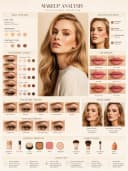
See your own result in 60 seconds
Personalized makeup guide: foundation, lips, eyes, blush recommendations
In this article · 10
- 1.The Drawer Full of Makeup I Never Used
- 2.Why Makeup Feels Overwhelming at the Start
- 3.The 3 Color Concepts Every Beginner Needs
- 4.The 4 Families, Translated Into Makeup
- 5.The 5-Product Starter Kit
- 6.A 10-Minute Routine for Beginners
- 7.6 Beginner Mistakes That Waste the Most Money
- 8.Where Technology Can Help (Without Replacing Your Eyes)
- 9.Key Takeaways
- 10.Related Articles
The Drawer Full of Makeup I Never Used
A few years ago I opened my bathroom drawer and counted. Thirty-one products. Seven lipsticks, four blushes, three eyeshadow palettes, and a foundation I had bought because a video told me it was "universally flattering." I regularly used exactly four of them.
The rest had been bought in moments of optimism: a sale, a tutorial, a friend's recommendation. None of them were bad products. They just weren't my products. Every time I tried one, I'd look in the mirror and feel vaguely off, but I couldn't explain why. So I assumed the problem was my skill, and I bought more.
The problem wasn't skill. It was that I had no system for choosing. Once I learned to use my color season as a filter, my drawer shrank to nine products, and for the first time I actually liked what I saw in the mirror.
If you're new to makeup and the whole thing feels overwhelming, this guide is for you.
Here's what you'll learn:
- Why makeup feels so overwhelming at the start (and why it isn't your fault)
- The only three color concepts a beginner needs
- A 5-product starter kit, matched to your season
- A simple 10-minute routine
- The beginner mistakes that waste the most money
Why Makeup Feels Overwhelming at the Start
Walk into any beauty store and you'll see hundreds of foundation shades, thousands of lip colors, and walls of palettes. The sheer number of choices is the first obstacle, not a lack of talent.
Most beginner advice makes this worse. "Just experiment!" is lovely if you have unlimited time and money. For everyone else, it means trial and error at fifteen to forty dollars a try.
What a beginner actually needs isn't more options. It's fewer, better-targeted options. That's exactly what color analysis gives you: a way to eliminate roughly 70 percent of the shelf before you even pick anything up.
The 3 Color Concepts Every Beginner Needs
Color analysis sounds technical, but for makeup you only need three ideas. Everything else is detail you can learn later.
1. Undertone: warm, cool, or neutral
Your undertone is the subtle hue beneath your surface skin color. Warm undertones lean golden, peachy, or yellow. Cool undertones lean pink, rosy, or blue-ish. Neutral undertones are a balance of both.
This is the single most important factor for makeup. A foundation that matches your depth but not your undertone will look gray, orange, or ashy no matter how well you blend it. If you're not sure of yours, my guide on how to determine your skin undertone walks through simple at-home checks.
2. Depth: light, medium, or deep
Depth is how light or dark your overall coloring is, including skin, hair, and eyes. It tells you how intense your makeup can be before it overwhelms your face. A very light complexion can be overpowered by a bold lip; a deep complexion can carry rich, saturated shades that would disappear on someone lighter.
3. Chroma: soft or bright
Chroma describes how muted or vivid your natural coloring is. If your features are softly blended (hair, skin, and eyes are close in tone), you're on the soft side and look best in diffused, blended makeup. If there's strong contrast and clarity in your coloring, you're on the bright side and can wear crisp, saturated color.
These three dimensions combine into the 12 color seasons. You don't need to memorize all twelve. For makeup, the four main families are enough to start.
The 4 Families, Translated Into Makeup
Here's the cheat sheet I wish I'd had on day one. Find the family closest to you, and treat the shades below as your "yes" list.
| Season family | Undertone | Blush | Lip | Eye |
|---|---|---|---|---|
| Spring | Warm, clear | Peach, apricot, warm coral | Coral, warm pink, peachy nude | Golden brown, champagne, soft olive |
| Summer | Cool, soft | Soft rose, dusty pink, mauve | Rosy nude, raspberry, soft berry | Taupe, soft plum, cool gray-brown |
| Autumn | Warm, muted | Terracotta, burnt peach, warm bronze | Brick, cinnamon, warm brown-nude | Bronze, copper, olive, warm brown |
| Winter | Cool, clear | Cool pink, berry, deep rose | True red, fuchsia, deep berry | Charcoal, navy, cool silver, plum |
A few notes so this doesn't become a rulebook:
- Neutral undertones can borrow from the family next to them. If you sit between Summer and Autumn, for example, soft rose-beige and muted terracotta shades often work for you.
- Soft seasons (Soft Summer, Soft Autumn) look best in blended formulas: cream blush, smudged eyeliner, satin lipstick.
- Bright seasons (Bright Spring, Bright Winter) can handle crisp definition: a clean lip line, a punchy blush, a graphic liner.
If you'd like the full 12-season version, my complete makeup color chart by season covers every sub-season in detail.
The 5-Product Starter Kit
This is where the system pays off. Instead of buying a full collection, start with five products. If you pick them with your season in mind, you can build a complete look from just these.
1. Foundation or skin tint
Choose by undertone first, depth second. Test three shades in a stripe along your jawline and check them in natural light. The right one disappears into your neck; the wrong one leaves a visible line. As a beginner, a lightweight skin tint is more forgiving than a full-coverage foundation. For a bit of background on how base products are formulated, Wikipedia's overview of foundation cosmetics is a surprisingly clear primer.
Foundations are where undertone mistakes show the most, so if yours never quite matches, read my undertone deep dive on why your foundation never matches.
2. Cream blush
If you buy one product to transform your face, make it a blush from your season's family. Blush brings your face to life and instantly makes a bare base look intentional. Cream formulas are the easiest for beginners: you can tap them on with your fingers and blend with no brush skills required.
3. A signature lip
Pick one everyday lip shade from your table row and wear it until you feel confident. A tinted balm or satin lipstick in a "my lips but better" shade is the safest option. Once that feels natural, you can branch into bolder colors.
4. One eye color
You don't need a thirty-pan palette. A single neutral shade in your family, applied across the lid with a fingertip or a flat brush, makes your eyes look more defined. Taupe for Summer, bronze for Autumn, golden brown for Spring, charcoal for Winter.
5. Brow product
Brows frame everything else. Choose a shade close to your natural brow hair, leaning slightly warm for Spring and Autumn, and slightly cool or ashy for Summer and Winter. A light hand matters more than the product itself.
Total: five products. That's not a limitation. It's a wardrobe with fewer, better pieces.
A 10-Minute Routine for Beginners
Once you have your five products, here's the routine I give every friend who asks:
- Base (2 minutes): Apply your skin tint or foundation with fingers or a damp sponge, focusing on the center of the face, then blend outward.
- Blush (1 minute): Tap cream blush on the apples of your cheeks and blend up toward your temples.
- Eyes (2 minutes): Sweep your neutral shade across the lid, and add a little along the lower lash line if you like.
- Brows (2 minutes): Fill in sparse areas with short, hair-like strokes. Brush through to soften.
- Lips (1 minute): Apply your signature lip and blot once.
- Check (2 minutes): Step back and look in natural light. If anything looks heavy, blend it with a clean fingertip.
You don't need to apply every step every day. Many days I only do blush, brows, and lips, and the difference from a bare face is dramatic.
6 Beginner Mistakes That Waste the Most Money
These are the traps I fell into, so you don't have to.
- Buying by the swatch on your hand. Hand skin often has a different undertone than your face. Test on your jaw or cheek instead.
- Choosing foundation that matches your neck in store lighting. Check it in daylight before leaving or ask for samples.
- Copying a tutorial exactly. A model with a different season will wear a color differently than you will. Use the technique, not the shades.
- Picking colors you "love" in the pan. A shade can be beautiful and still make you look tired. Trust how it looks on you, not in the pan.
- Buying a full palette for one shade. If you only love two colors in a palette, buy those two as singles.
- Skipping blush. The most transformative and most overlooked product for beginners.
Where Technology Can Help (Without Replacing Your Eyes)
The hardest part of this system is the first step: knowing your season. Draping cloths over your shoulders in front of a mirror works, but it's easy to misjudge, especially under bad lighting.
This is where AI tools have become genuinely useful. Upload a bare-face selfie in natural light, and a good analysis tool reads your undertone, depth, and chroma, then translates them into makeup shades. I tried a free tool like aicoloranalysis.io before a big makeup shopping trip, and it gave me a clear list of foundation, lip, and blush families. It didn't replace the mirror test, but it saved me from several wrong turns.
If you want a wider, jargon-free introduction to all of this, there's a beginner-focused color analysis starter guide that covers the basics step by step.
Key Takeaways
- Overwhelm comes from too many choices, not too little skill. A filter fixes that.
- Undertone comes first. Match warm, cool, or neutral before worrying about shade depth.
- Start with five products: a skin tint, cream blush, signature lip, one eye shade, and a brow product.
- Use your season family as a "yes" list. You'll buy fewer products and wear more of them.
- Test on your face, in daylight. Your hand and store lighting will mislead you.
Makeup is supposed to be fun, not a test you can fail. When your shades are working with your natural coloring instead of fighting it, everything gets easier: faster routines, less money wasted, and a face that looks like itself on a good day. Start with five products, give them a week, and see how it feels.
Related Articles
- The Best Makeup Colors for Every Color Season: A Complete Chart — The full 12-season chart for foundation, lips, eyes, and blush
- Why Your Foundation Never Matches: An Undertone Deep Dive — Fix undertone mistakes in your base
- How to Determine Your Skin Undertone — Simple at-home tests for warm, cool, or neutral
- How to Find the Perfect Red Lipstick for Your Skin Tone — Graduate from nude lips to your signature red
- Color Analysis for Beginners — A jargon-free starter guide
- Color Analysis: The Complete Guide — Everything you need to know about finding your best colors
Want to try AI color analysis yourself?
Upload one photo and get a magazine-level beauty report in 60 seconds.
Start Free AnalysisRelated Posts
I Tried Color Analysis on My Entire Friend Group — 5 Women, 5 Seasons, 5 Surprising Lessons
What happens when five friends discover their color seasons together? A personal story about the surprises, the arguments, and the shopping spree that followed.
7 Color Analysis Myths TikTok Gets Wrong
TikTok made color analysis viral — and spread major myths. We debunk the 7 biggest misconceptions with facts. See what your season really means.
Color Analysis for Dark Skin: Full Guide
Color analysis works beautifully for melanin-rich skin. Find your season, best palette & styling tips for dark and deep skin tones. Free AI tool included.
Color Analysis for Men: Find Your Best Colors (Complete Guide)
Personal color analysis isn't just for women. Learn how men can find their seasonal color type and use it for suits, casual wear, grooming, and professional attire.