Why Your Foundation Never Matches: An Undertone Deep Dive

By Lydia He
Co-Founder of Belle AI
Upload a selfie to get 3 makeup looks with exact lip, cheek and eye shades
In this article · 10
- 1.Why That "Perfect" Foundation Stopped Working
- 2.It's Not the Shade — It's the Undertone
- 3.Why Standard Matching Methods Fail
- 4.How to Actually Determine Your Skin's Undertone
- 5.The Olive Undertone Problem (And Why It's So Hard to Match)
- 6.Foundation Matching by Season Type
- 7.The Oxidation Factor Nobody Warns You About
- 8.A Practical Shopping Checklist
- 9.Key Takeaways
- 10.Related Articles
Why That "Perfect" Foundation Stopped Working
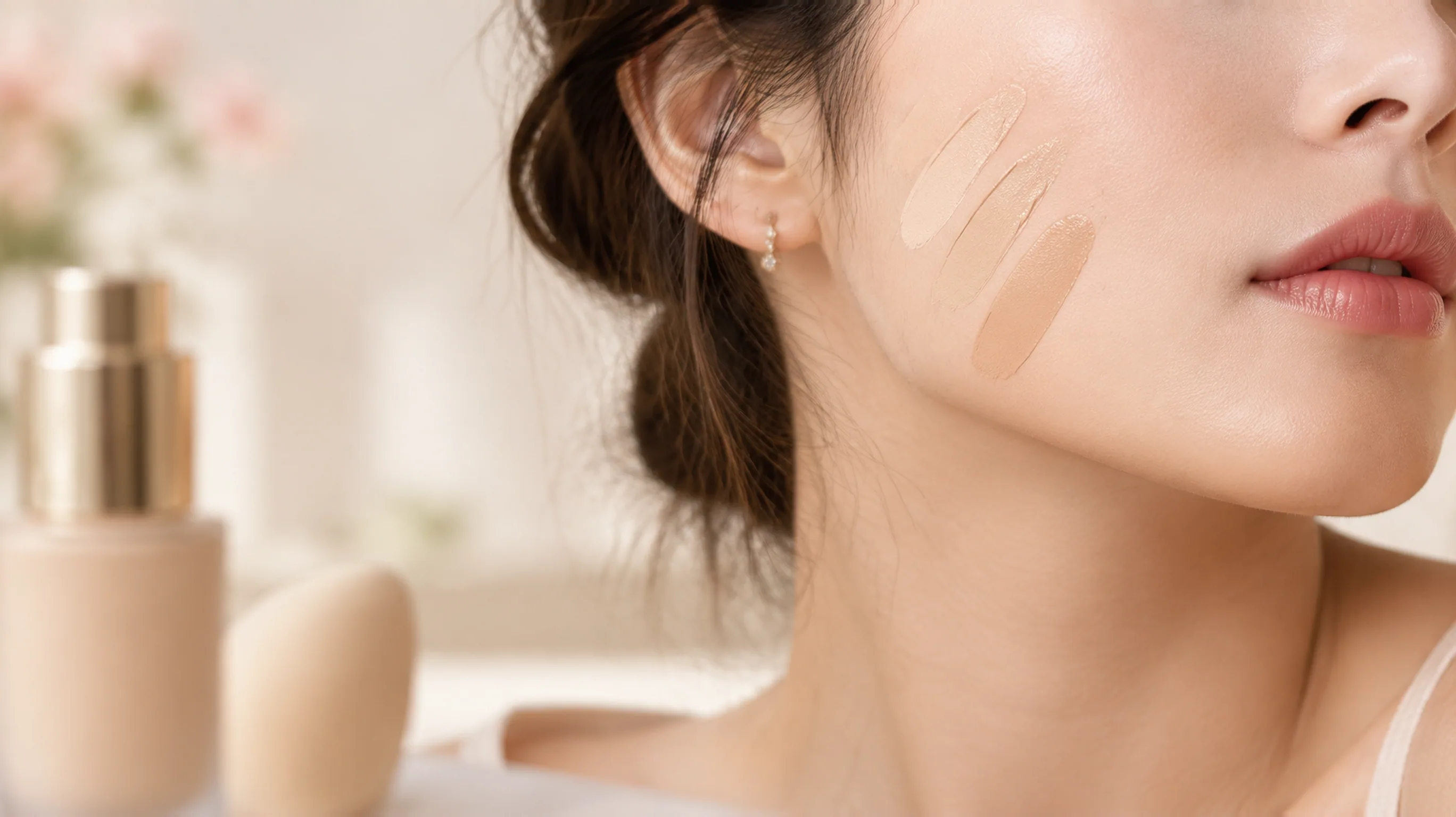
Many people end up with a drawer of abandoned foundations — bottles that looked right under store lights but wrong in daylight. The swatch on the jawline looked convincing; by afternoon you might see an unmistakable yellow cast, an ashy gray undertone pulling away from your skin, or a pinkish mask that reads as foundation rather than your skin, but better.
If this sounds familiar, here's the short version. The mismatch is usually undertone, not shade depth — and the fix is more straightforward than trying another dozen bottles at the wrong axis.
It's Not the Shade — It's the Undertone
Here's the fundamental mistake most people make: they focus exclusively on how light or dark a foundation is (the shade), while ignoring the color beneath the color (the undertone).
Shade depth is straightforward. You can tell with your eyes whether a foundation is too light or too dark. But undertone mismatch is sneaky — it creates that "something's off" feeling without being obvious about why. A foundation can be the perfect depth and still look completely wrong if the undertone doesn't match your skin.
What is undertone, exactly? It's the color that sits beneath the surface of your skin, independent of how light or dark you are. Two people can have identical shade depth — say, a medium beige — but look completely different in the same foundation because one has warm (golden/peach) undertone and the other has cool (pink/blue) undertone.
Foundation undertones fall into four categories:
- Warm: Golden, peachy, or yellow-based. These formulas look sun-kissed on warm skin and sallow on cool skin.
- Cool: Pink, red, or blue-based. These look fresh on cool skin and artificially rosy on warm skin.
- Neutral: A balanced mix. These are the most forgiving, but they're not universally flattering — they can look flat on strongly warm or cool skin.
- Olive: A green-yellow modifier that exists on top of warm or cool undertones. The rarest and most frequently mismatched category.
 Sample report
Upload a selfie to get 3 makeup looks with exact lip, cheek and eye shades
Why Standard Matching Methods Fail
The Jawline Swatch Problem
Swiping foundation on your jawline tells you about shade depth, but it's terrible for undertone assessment. Your jaw receives less sunlight than your cheeks, your forehead is a different color entirely, and store lighting (usually warm LED or fluorescent) distorts undertone perception.
Many people end up wearing the wrong foundation undertone even when they believe their match is correct. A common culprit: testing in artificial light.
The "Match to Your Neck" Myth
This advice assumes your face and neck share the same undertone, which often isn't true. Your neck may be lighter and show more vein color. Your face has more blood flow near the surface, adding redness. And if you've had any sun exposure at all, your facial skin has shifted warmer while your neck stayed closer to its natural state.
The Celebrity Shade Name Trap
Foundation names are marketing, not science. "Sand," "Buff," "Beige," and "Natural" mean different things at every brand. Clinique's "Neutral" leans warm. MAC's "NC" (Neutral Cool) actually runs warm. NARS "Deauville" has olive undertones that look muddy on cool skin. You cannot shop by name alone.
How to Actually Determine Your Skin's Undertone
Forget the vein test (unreliable) and the jewelry test (subjective). Here are five methods that actually work, ranked by accuracy:
1. The Bare Skin Daylight Test
Strip your skin bare — no moisturizer, no primer, no residual product. Wait 20 minutes. Stand near a north-facing window (indirect natural light, no direct sun). Hold a white piece of paper next to your cheek.
What you're looking for:
- Warm undertone: Your skin looks golden, peachy, or slightly yellow against the white paper
- Cool undertone: Your skin looks pink, rosy, or slightly blue
- Neutral undertone: Your skin doesn't pull strongly in either direction — it just looks "skin colored"
- Olive undertone: You see a faint greenish or grayish cast, especially around the mouth and under the eyes
2. The White T-Shirt Test
Wear a pure white (not cream, not ivory) t-shirt in natural light. How does it make your face look?
- If your face looks healthier and brighter → you likely have cool undertone (white has blue undertones that harmonize)
- If your face looks slightly washed out or sallow → you likely have warm undertone (try the same test with an off-white or cream shirt)
- If it looks fine either way → neutral
3. The Two-Foundation Comparison
Go to a makeup counter and ask for two samples of the SAME shade depth — one in a warm formula and one in a cool formula. Wear each on half your face for a full day in natural light. The wrong undertone becomes glaringly obvious after several hours, even if both looked "fine" during a quick swatch.
This is one of the most reliable consumer tests for undertone. It takes patience, but it eliminates guesswork entirely.
4. The Inner Wrist Method (Improved)
The standard vein test is unreliable because vein color depends on depth, light conditions, and individual anatomy. But the inner wrist is useful for one thing: it shows your skin at its most untanned and unmodified.
Look at the overall skin tone of your inner wrist in natural light (ignore the veins). Compare it to the skin on your cheek:
- If they're similar → your face hasn't shifted much from your natural undertone
- If your cheek looks warmer/more golden → sun exposure has added warmth; your TRUE undertone is closer to your wrist
5. AI-Powered Undertone Analysis
Technology can help here as a second opinion. AI color analysis tools judge your undertone from a selfie, trying to separate it from surface color, tan, and redness, though lighting and camera settings can still shift the result. They are most helpful as a cross-check for tricky cases like olive undertones or neutral-leaning skin that confuses human eyes.
Tools like aicoloranalysis.io can analyze your undertone from a selfie and suggest foundation shades based on your coloring.
The Olive Undertone Problem (And Why It's So Hard to Match)
If you've always struggled to find foundation — if warm shades look too yellow and cool shades look too pink and neutral shades look weirdly gray — you might be olive.
Olive undertones are common, yet most foundation lines offer few or no olive-specific shades. Instead, olive-skinned people are forced to choose between "the least bad option" from warm, cool, or neutral categories.
What makes olive different: Olive isn't warm or cool — it's a green-yellow modifier that sits on TOP of your warm or cool undertone. You can be warm-olive (golden green) or cool-olive (grayish green). This extra dimension is why standard two-axis matching (warm vs. cool × light vs. dark) always feels slightly off.
Signs you might be olive:
- Foundation oxidizes strangely on you (turns orange or grayish within hours)
- You look good in both gold AND silver jewelry, but muted versions of each
- Your skin has a subtle greenish or grayish cast, especially bare
- Earth tones (olive green, terracotta, warm brown) look incredibly natural on you
- Bright pure white makes you look sickly, but off-white looks great
Olive foundation strategy:
- Look for brands that explicitly offer olive ranges (Koh Gen Do, Danessa Myricks, RCMA, Armani)
- If your brand doesn't have olive, start with a warm shade and mix in a tiny amount of green color corrector
- Set with a yellow-green translucent powder rather than pink or colorless
- Accept that your "perfect match" might be a custom mix, not a single product
Foundation Matching by Season Type
Your personal color season gives strong clues about your foundation undertone:
Spring seasons (Light Spring, True Spring, Bright Spring): Foundation undertone: Warm. Look for golden, peachy formulas. Springs often oxidize warm, so go slightly lighter than your match looks in-store.
Summer seasons (Light Summer, True Summer, Soft Summer): Foundation undertone: Cool to neutral-cool. Look for pink or neutral formulas. Avoid anything described as "golden" or "sun-kissed."
Autumn seasons (Soft Autumn, True Autumn, Deep Autumn): Foundation undertone: Warm to warm-olive. Autumns have the richest, most golden skin tones. Look for warm, earthy formulas. Many Deep Autumns do well with olive-leaning shades.
Winter seasons (Deep Winter, True Winter, Bright Winter): Foundation undertone: Cool. Winters have the most contrast between skin and features. Look for neutral-cool to cool formulas. Avoid warm shades — they make Winter coloring look muddy.
The Oxidation Factor Nobody Warns You About
Even a perfect undertone match can fail after a few hours thanks to oxidation — the chemical reaction between your skin's oils, pH level, and the foundation's pigments.
Foundation almost always oxidizes WARMER. That means:
- Cool undertone skin: Your foundation shifts away from your natural tone, creating an increasingly visible mismatch throughout the day
- Warm undertone skin: Your foundation may become too warm, looking orange
- Olive undertone skin: Oxidation plus olive = that dreaded "muddy" look
How to test for oxidation: Apply your prospective foundation to your jawline in the morning. Take a photo in natural light immediately, then again after 4 hours. Compare. If the color has shifted noticeably, either:
- Choose a shade with slightly cooler undertone to compensate for the warm shift
- Use a silicone-based primer (creates a barrier that slows oxidation)
- Set with a color-correcting powder that pulls slightly cool
A Practical Shopping Checklist
Next time you foundation-shop, use this checklist:
Before you go:
- Know your undertone category (warm/cool/neutral/olive)
- Know your color season (this narrows options dramatically)
- Check the brand's undertone system online (every brand codes differently)
- Go with a bare, clean face — no moisturizer or SPF that could affect undertone reading
At the counter:
- Ask for TWO shades in your depth — one warm-leaning, one cool-leaning
- Swatch on your cheek (not jaw) in natural light (step outside if possible)
- Take samples home and wear each for a full day
- Check your match at noon in direct daylight AND in evening indoor light
- Photograph at the 4-hour mark to check for oxidation shift
Decision time:
- The right match should look like your skin, but better — not like a layer ON your skin
- If neither sample is right, you may need a different brand's undertone formula entirely
- If you consistently fall "between" warm and cool, explore olive or neutral-olive shades
Key Takeaways
- Shade depth is easy; undertone matching is where most people go wrong. A foundation can be the perfect lightness/darkness and still look terrible if the undertone conflicts with your skin.
- The four undertone categories — warm, cool, neutral, and olive — each need different foundation formulas. Standard "neutral" is not a universal solution.
- Test in natural daylight, on your cheek, over several hours. Quick in-store swatches under artificial light are the #1 reason for foundation mismatches.
- Olive undertone is real, common, and chronically underserved by most foundation lines. If warm looks too yellow and cool looks too pink, explore olive-specific brands or custom mixing.
- Oxidation always shifts warm. Account for it by choosing a slightly cooler shade than your initial match suggests.
Finding your foundation match isn't about trying more shades — it's about understanding the dimension you've probably been ignoring. Once you nail undertone, mismatched bottles stop piling up.
Related Articles
- Neutral Undertone: The Hardest Skin Tone to Diagnose (Here's How) — Why neutral undertone breaks standard tests and how to identify it
- The Best Makeup Colors for Every Color Season: A Complete Chart — Foundation, lips, eyes, and blush recommendations by season
- Olive Undertone: The Most Misunderstood Skin Tone Explained — Deep dive into olive undertone identification and styling
- Color Analysis: The Complete Guide — Everything you need to know about finding your best colors
Upload a selfie to get 3 makeup looks with exact lip, cheek and eye shades
Get my makeup looks →Free · No signup needed
Related Posts
Olive Skin Foundation Guide: How to Find Your Perfect Match
Warm foundation turns orange, cool turns pink? Olive undertones need yellow-green bases. See which brands carry olive shades and how to match.
Olive Undertone: The Most Misunderstood Skin Tone Explained
Neither gold nor silver looks right? Foundation turns orange or pink? You may have olive undertones. See 5 clear signs and take a free AI test.
The Brunette Guide: How to Choose the Right Brown Hair Color for Your Skin Undertone
Brown isn't one color. Depth, temperature, and color season decide whether chocolate, chestnut, mocha, or ash brown makes you glow or look flat.
Olive vs Neutral Undertone: How to Tell the Difference
Quizzes say neutral but nothing looks right? You may be olive. Compare green cast, foundation and jewelry behavior, then confirm with a 4-step drape test.