Olive vs Warm Undertone: Why Olive Skin Isn't Simply Warm
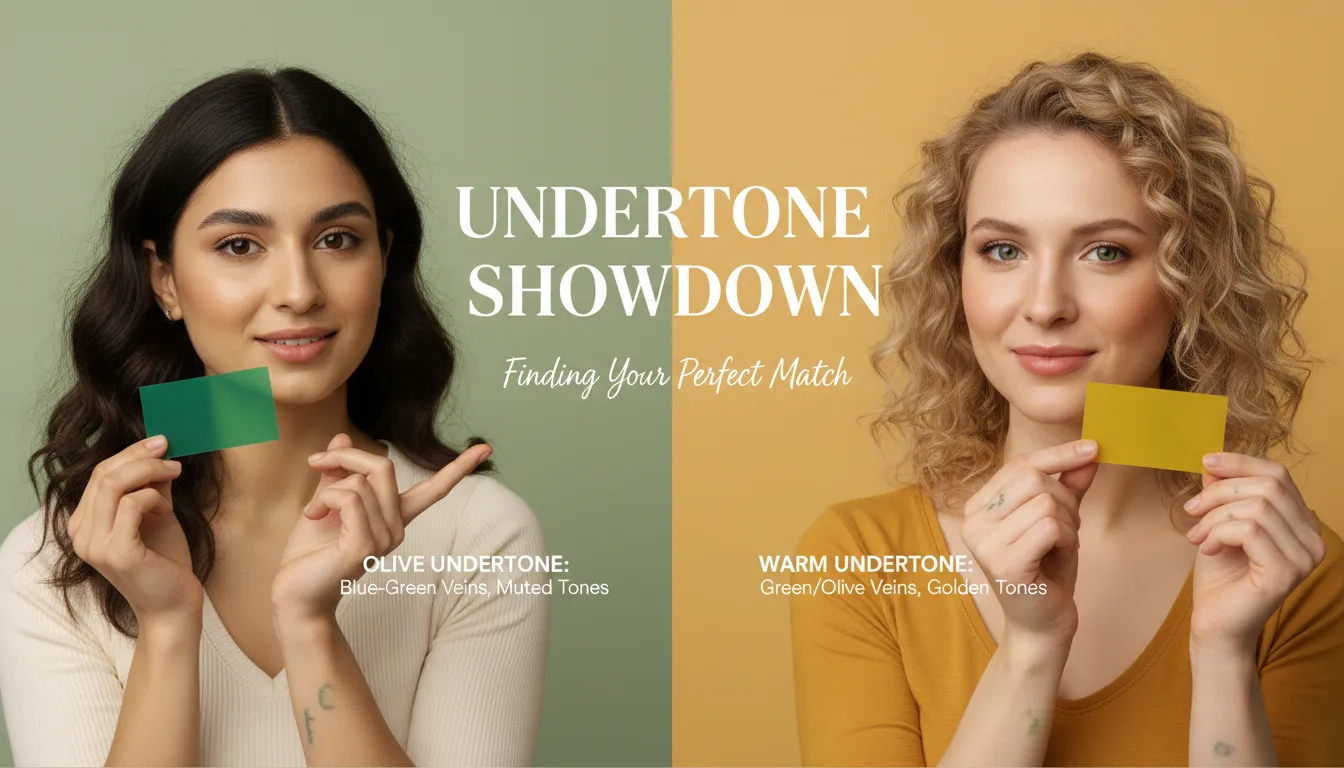
"You Must Be Warm-Toned" — The Advice Olive Skin Gets Wrong
If you have olive undertones, someone has probably told you you're warm-toned. Your veins look greenish. You tan easily. Warm colors seem to work sometimes. A department store consultant matched you to a golden foundation. Case closed, right?
Not quite. Olive skin is one of the most common undertones globally, and it's routinely misclassified as warm because the standard warm/cool framework doesn't account for the green-grey modifier that defines olive skin. Warm olive exists — but olive itself is not the same thing as warm, and treating it as warm leads to orange foundation, sallow hair color, and clothing choices that almost work but never quite glow.
This guide explains why olive is neither warm nor cool, which test results mislead, and how color matching differs when you're olive versus genuinely warm-toned.
Why Olive Is Neither Warm Nor Cool
Olive Is a Modifier, Not a Base Undertone
The beauty industry treats undertones as a spectrum from cool (pink/blue) to warm (yellow/golden). Olive doesn't sit on this spectrum — it sits on top of it.
Think of your undertone as two layers:
- Base undertone: warm, cool, or balanced (determined by hemoglobin and carotene)
- Olive modifier: a green-grey pigmentation layer caused by melanin interacting with both warm and cool pigments
This means you can be:
- Warm olive — golden base + green modifier
- Cool olive — pink/blue base + green modifier
- Neutral olive — balanced base + green modifier
The olive modifier is what makes your skin unique. It's also what makes standard warm/cool advice fail.
Why This Matters Practically
A genuinely warm-toned person has clear yellow/golden pigmentation without any green cast. Warm colors with golden undertones look harmonious because the skin and the color share the same base.
An olive-toned person has a green-grey cast that neutralizes both warm and cool signals. Warm colors need to be muted (not golden) to work. Cool colors need to be soft (not icy) to work. Pure warm — the kind that makes truly warm skin glow — makes olive skin look sallow and orange.
See your personal color palette now
Upload a photo — get your AI beauty report in 60 seconds.
Test Results That Mislead
The Vein Test
What happens: Olive veins appear greenish or blue-green.
Why it misleads: The vein test chart says green veins = warm. But olive veins are green for a different reason — the green-grey skin modifier affects how veins appear through the skin. Olive veins aren't green because of a golden base; they're green because of the olive pigment layer.
Warm-toned veins look clearly green against the skin because of yellow/golden undertones. Olive veins look greenish-blue or teal — a different quality entirely.
The Tanning Test
What happens: Olive skin tans easily and deeply.
Why it misleads: Easy tanning is associated with warm undertones. But olive skin tans golden-brown (not red) because of its unique melanin composition, not because of a warm base. Cool olive skin also tans easily — the tanning response doesn't indicate warm undertones.
Warm-toned tanning often produces golden or copper tones. Olive tanning produces a deeper, more greenish-brown tan that can look almost grey in certain light.
The Jewelry Test
What happens: Gold jewelry looks "okay" on olive skin — not bad, not amazing.
Why it misleads: People interpret "gold doesn't look terrible" as "must be warm." But gold looking merely acceptable (rather than clearly flattering) is actually an olive indicator. On genuinely warm skin, gold looks clearly better than silver — there's no ambiguity.
Warm-toned jewelry response: Gold clearly wins. Silver looks off. Olive jewelry response: Both look decent. Rose gold often looks best. Neither is a clear winner.
The "Warm Colors Suit You" Observation
What happens: Some warm colors look good on olive skin.
Why it misleads: Muted warm colors (terracotta, warm taupe, olive green) do suit olive skin — but for different reasons than they suit warm skin. On warm skin, these colors harmonize with golden undertones. On olive skin, they harmonize because they're muted enough to work with the green cast.
The critical test: do bright, saturated warm colors (bright orange, golden yellow, warm coral) look good? If muted warm works but bright warm doesn't, you're olive — not warm.
Side-by-Side Comparison
| Characteristic | Warm Undertone | Olive Undertone |
|---|---|---|
| Skin cast | Golden, yellow, peachy | Green-grey, sometimes sallow |
| Veins | Clearly green | Greenish-blue, teal, or mixed |
| Gold jewelry | Clearly flattering | Acceptable but not perfect |
| Silver jewelry | Often looks off | Acceptable but not perfect |
| Warm foundation | Melts in seamlessly | Turns orange or too yellow |
| Cool foundation | Looks pink/ashy | Also looks pink/ashy |
| Bright orange | Often flattering | Makes skin look sallow |
| Muted terracotta | Flattering | Flattering (different reason) |
| Bright white | May look fine | Makes skin look grey-green |
| Cream/off-white | Good alternative | Better choice than white |
| Tan result | Golden, coppery | Golden-brown, slightly green |
| Best color family | Clear warm tones | Muted earthy tones |
Color Matching Differences
Foundation
Warm undertone: Warm/golden foundations blend seamlessly. NC/NW warm ranges work well. Shade matching is relatively straightforward.
Olive undertone: Warm foundations look orange. Cool foundations look pink. Need olive-specific or yellow-green shades. Shade matching is notoriously difficult without olive-labeled options.
Lipstick
Warm undertone: Coral, peach, warm red, golden nude all work beautifully. Blue-red is the main color to avoid.
Olive undertone: Berry, mauve, brick red, warm nude (brown-based). Coral is controversial. Blue-red turns muddy. Peach nudes disappear.
Hair Color
Warm undertone: Golden blonde, copper, auburn, warm brown all enhance the complexion. Ash tones are the main risk.
Olive undertone: Rich chocolate brown, muted auburn, caramel highlights. Golden blonde and copper look brassy. Ash tones look dull.
Clothing
Warm undertone: Clear warm colors — camel, coral, golden yellow, warm red, peach. Can handle moderate saturation.
Olive undertone: Muted earthy tones — olive green, warm taupe, terracotta, dusty rose, sage. High saturation in any direction causes problems.
Blush
Warm undertone: Peach, coral, warm pink all work. Bright, clear blush colors are flattering.
Olive undertone: Dusty rose, soft peach, terracotta, warm mauve. Bright pink looks stripey and disconnected from the skin.
"But I Have Warm Olive — Isn't That Warm?"
Yes — warm olive has a warm base. But the olive modifier changes how that warmth presents and what colors work:
Warm olive can wear: Muted warm colors — terracotta, warm taupe, camel, soft peach, brick red
Warm olive should avoid: Bright warm colors — orange, golden yellow, bright coral, copper hair
The "warm" in warm olive describes your base undertone. The "olive" describes how you need to filter every color choice through a muted, earthy lens that pure warm-toned people don't need.
If you're warm olive and you've been choosing colors for "warm undertones" using standard warm-toned guides, that explains why some recommendations worked (the muted ones) and others didn't (the bright ones).
How to Confirm Your Undertone
- Test bright vs muted warm: If terracotta flatters you but bright orange doesn't, you're olive (possibly warm olive)
- Check foundation behavior: If warm foundations consistently turn orange, you're not standard warm
- Compare against known warm-toned person: Stand next to someone clearly warm-toned. If your skin has a greenish quality theirs lacks, you're olive
- Try AI analysis: Computer vision detects the green-grey cast that distinguishes olive from warm
Key Takeaways
- Olive is a modifier, not a warm undertone — it sits on top of warm, cool, or neutral bases
- Standard warm tests mislead because olive shares some surface characteristics with warm (greenish veins, easy tanning) for different underlying reasons
- The bright vs muted test is decisive — warm skin handles saturated warm colors; olive skin needs muted versions
- Warm olive exists but requires different color choices than standard warm — muted earthy tones, not clear golden ones
- Foundation behavior is the most practical diagnostic — orange warm foundation = you're not standard warm
Understanding that you're olive (not simply warm) is the shift that makes color choices finally click into place.
Find Your True Undertone
Warm or olive? Our AI analysis detects the green-grey modifier that standard tests miss — and tells you whether you're warm olive, cool olive, or neutral olive.
60 seconds, free, no signup. Accurate undertone detection for olive skin.
Related Articles
- Color Analysis: The Complete Guide — Everything you need to know about finding your best colors
- Olive Undertone Guide — The complete guide to identifying and styling olive skin
- Olive vs Neutral Undertone — How to tell olive apart from neutral skin
- Olive Skin Color Season Guide — Which seasonal type olive skin typically falls into
Want to try AI color analysis yourself?
Upload one photo and get a magazine-level beauty report in 60 seconds.
Start Free Analysis