Olive vs Neutral Undertone: How to Tell the Difference
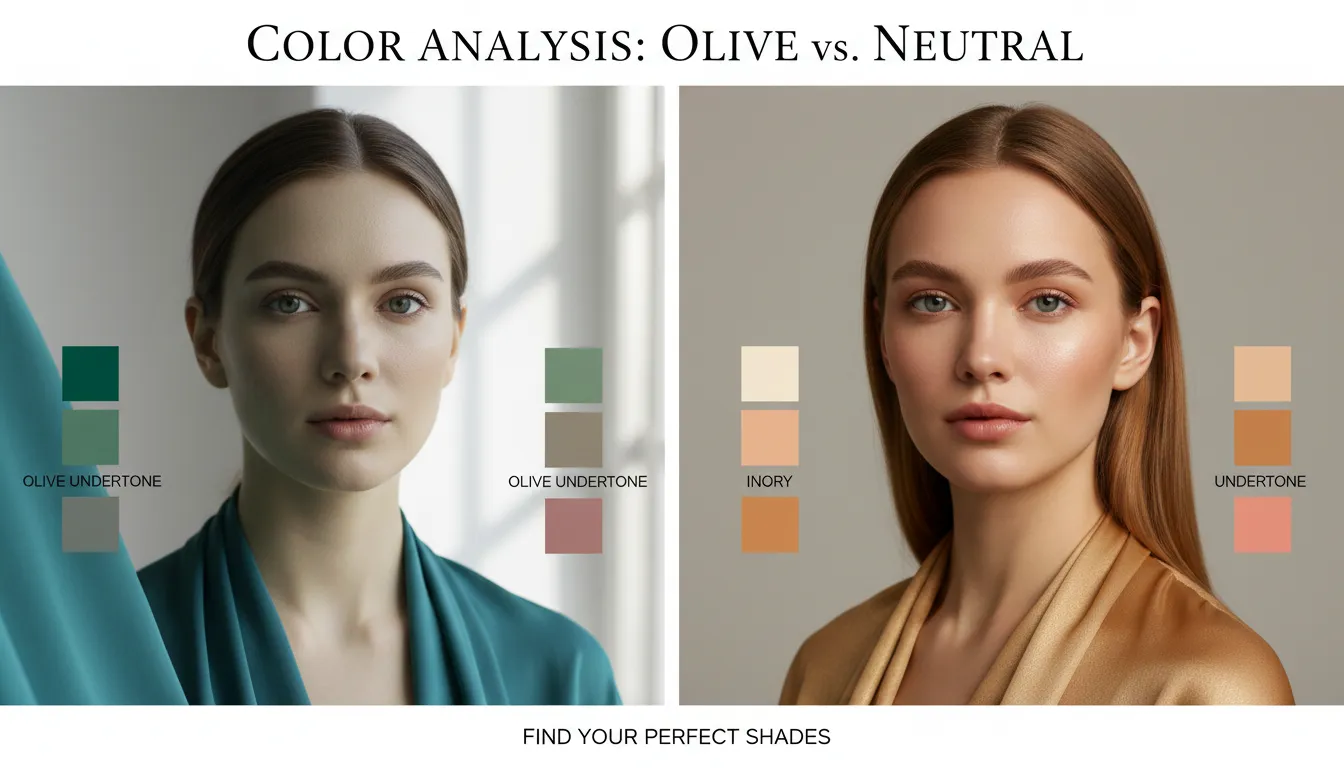
The Most Common Undertone Misidentification
Walk into any beauty forum and you'll find the same story repeated hundreds of times: "Every quiz says I'm neutral, but nothing looks right on me." Warm foundations turn orange. Cool foundations look pink. Gold and silver jewelry both look okay but neither looks perfect. Veins appear blue-green in a way that doesn't match any chart.
These people aren't neutral — they're olive. And olive undertones get misidentified as neutral more often than any other undertone gets misidentified at all.
The confusion makes sense. Olive skin sits between warm and cool, canceling out the signals that standard tests rely on. But olive and neutral are fundamentally different, and understanding that difference changes everything about how you choose makeup, clothing, and hair colors.
Why Olive Gets Typed as Neutral
The Cancellation Effect
Olive undertones include a green-grey modifier that sits on top of a warm or cool base. This green cast masks your true base undertone, making warm and cool signals appear balanced — which standard tests interpret as "neutral."
When you take the vein test, your veins look blue-green rather than clearly blue or clearly green. When you try the jewelry test, both gold and silver look decent but neither is clearly better. When you drape warm and cool colors, both can look slightly off — which quizzes read as "you're neutral, both work."
But the reason both warm and cool look "off" on olive skin isn't because you're balanced between them. It's because olive needs muted versions of warm and cool — not pure, saturated versions of either.
The Industry Gap
Most beauty education still teaches three undertones: warm, cool, neutral. Olive isn't mentioned as a distinct characteristic. So when someone doesn't fit cleanly into warm or cool, the default answer is neutral — even when a green cast is clearly visible.
Online quizzes make this worse. They ask binary questions ("Do warm or cool colors look better?") without an olive option. If you answer "neither, both look weird," the algorithm types you as neutral.
See your personal color palette now
Upload a photo — get your AI beauty report in 60 seconds.
Key Differences: Olive vs Neutral
The Green Cast
This is the defining difference.
Olive skin has a visible green or grey-green cast, especially noticeable:
- Against pure white fabric (skin looks grey or greenish)
- On the neck and jawline
- In natural daylight
- When compared directly to non-olive skin
Neutral skin lacks this green cast. Against white, neutral skin looks clearly warm (yellow/golden) or clearly cool (pink/rosy) — just balanced between the two. There's no greenish or greyish quality.
Quick test: Hold a white piece of paper against your face in natural light. If your skin looks grey-green or sallow against the white, you're likely olive. If it looks evenly warm or evenly cool without any green, you're likely neutral.
Jewelry Test Behavior
Olive: Both gold and silver look acceptable but neither looks perfect. Rose gold often looks best because it bridges warm and cool without clashing with the green cast. You might feel genuinely uncertain rather than having a clear preference.
Neutral: One metal typically looks noticeably better. True neutrals often find both work well, but there's a clear harmony with at least one metal type. There's no sense of "something is off with both."
Foundation Matching
Olive: Neither warm nor cool foundations work correctly. Warm turns orange. Cool turns pink or ashy. You need olive-specific or yellow-green based shades. This is often the most reliable diagnostic.
Neutral: Standard neutral foundations work reasonably well. You might prefer slightly warm or slightly cool within the neutral range, but you don't experience the dramatic mismatch that olive skin does.
Color Draping Results
Olive: Pure warm colors (bright orange, golden yellow) and pure cool colors (icy blue, bright fuchsia) both make you look sallow or grey. But muted versions of warm and cool — dusty rose, soft teal, warm taupe — make your skin glow.
Neutral: Both warm and cool color families can work, depending on whether you lean warm-neutral or cool-neutral. You don't need everything to be muted — you can handle more saturation than olive skin typically can.
How to Distinguish via Draping
Professional color analysts use fabric draping to identify undertones. You can do a simplified version at home:
Step 1: Test Pure Warm vs Pure Cool
Hold a bright orange fabric near your face, then a bright fuchsia.
- If both look bad (sallow with orange, grey with fuchsia), olive is likely
- If one clearly looks better, you may be warm-neutral or cool-neutral rather than olive
Step 2: Test Muted Versions
Hold a dusty rose fabric, then a warm taupe.
- If both look good and your skin looks clearer, olive is confirmed
- If you preferred one of the pure colors in Step 1, you're more likely neutral
Step 3: Check the Green
Look at your skin next to someone you know is clearly warm or clearly cool.
- If your skin has a greenish or greyish quality theirs lacks, you're olive
- If your skin just looks less warm or less cool than theirs, you're neutral
Step 4: AI Analysis Confirmation
Standard draping tests can still be ambiguous for borderline cases. AI color analysis measures the actual color values in your skin — including the green-grey cast that's invisible to casual observation but clearly detectable by computer vision. This is the most reliable way to distinguish olive from neutral.
Season Implications
Getting your undertone right affects your seasonal color analysis placement:
If You're Olive (Not Neutral)
You'll likely type into:
- Soft Autumn (warm olive, muted)
- Soft Summer (cool olive, muted)
- Deep Autumn (warm olive, deep)
- Deep Winter (cool olive, deep)
Your palette will emphasize muted, earthy tones rather than clear warm or cool families.
If You're Truly Neutral
You'll likely type into:
- True Autumn or True Spring (warm-neutral)
- True Summer or True Winter (cool-neutral)
- Or a Light/Bright season depending on depth and contrast
Your palette will have more flexibility with saturation and can include clearer warm or cool tones.
The Practical Difference
An olive person typed as neutral will get color recommendations that are "almost right" — close enough to seem plausible but never quite making their skin glow. An olive person correctly identified gets muted, earthy palettes that actually harmonize with their green cast.
Common Scenarios
"I'm neutral but warm colors look orange on me"
You're likely warm olive, not warm-neutral. The orange appearance means pure warm is too saturated for your green cast. You need muted warm — terracotta, not bright orange.
"I'm neutral but cool colors make me look grey"
You're likely cool olive, not cool-neutral. The grey appearance means pure cool is fighting your green cast. You need muted cool — dusty rose, not bright fuchsia.
"Both gold and silver look fine but nothing looks amazing"
Classic olive signature. True neutrals usually have a clearer preference. Rose gold is worth trying — it often resolves the olive jewelry dilemma.
"Neutral foundation works but looks slightly off in daylight"
You might be very subtle olive or neutral with olive tendencies. Try an olive-specific foundation and compare side by side in natural light. The difference is often immediately visible.
Key Takeaways
- Olive is not neutral — it's a green-grey modifier that masks warm/cool signals, causing misidentification
- The green cast is the key differentiator — visible against white, on jawline/neck, in natural daylight
- Both warm and cool look "off" on olive for different reasons than they do on neutral skin
- Muted colors reveal olive — if dusty rose and warm taupe both flatter you while pure warm and pure cool don't, you're olive
- AI analysis is the most reliable distinguisher for borderline cases
Stop accepting "neutral" as your undertone if the label never quite fit. You might be olive — and that changes everything.
Find Your True Undertone
Not sure if you're olive or neutral? Our AI color analysis detects the green-grey cast that standard tests miss.
60 seconds, free, no signup. Get an accurate undertone reading including olive detection.
Related Articles
- Color Analysis: The Complete Guide — Everything you need to know about finding your best colors
- Olive Undertone Guide — The complete guide to identifying and styling olive skin
- Olive vs Warm Undertone — Why olive skin isn't simply warm or cool
- How to Determine Your Skin Undertone — Seven testing methods for undertone identification
Want to try AI color analysis yourself?
Upload one photo and get a magazine-level beauty report in 60 seconds.
Start Free Analysis