Ton froid vs ton chaud : 5 tests faciles pour trouver votre sous-ton (avec photos)
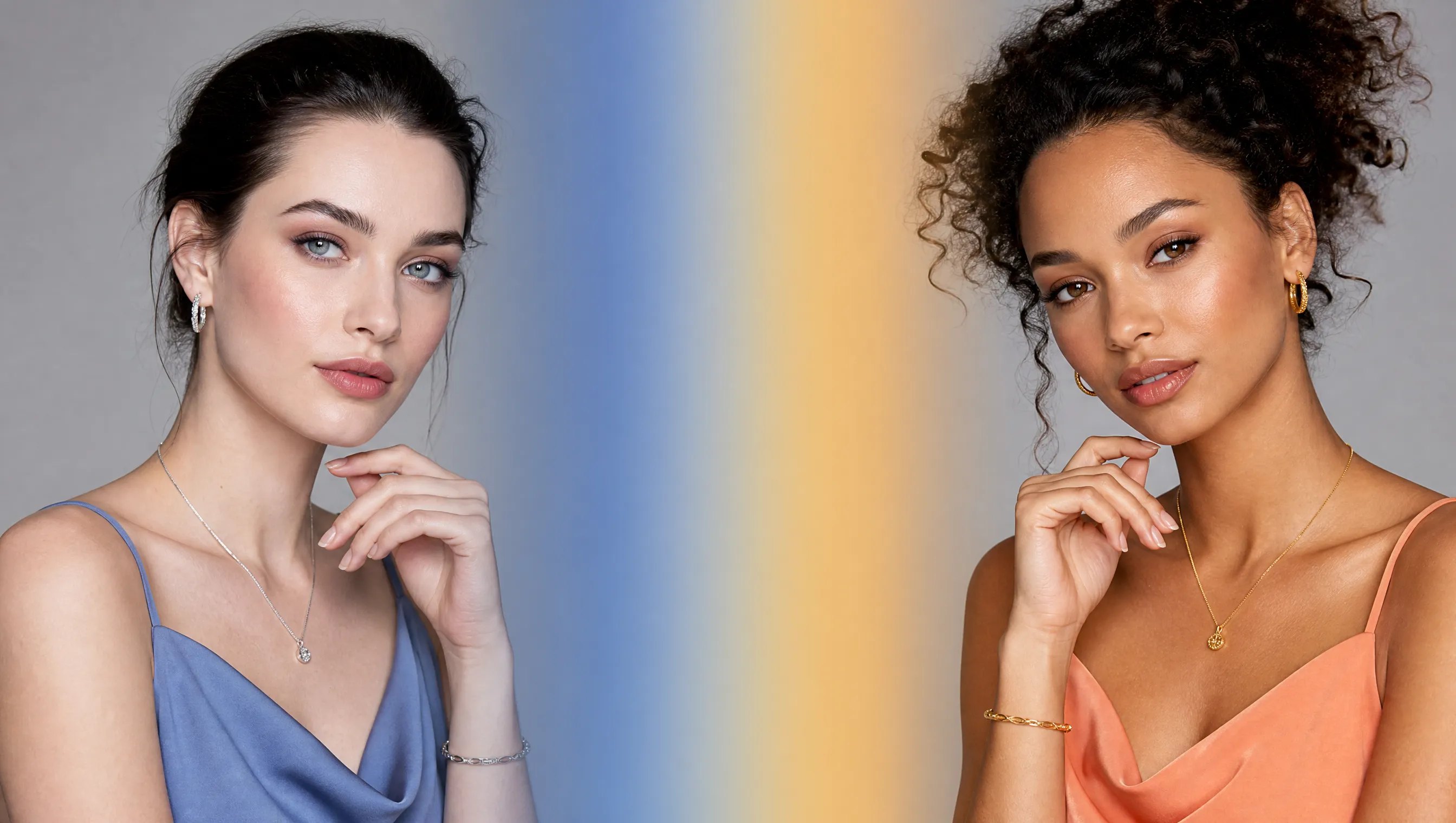
Qu'est-ce qu'un sous-ton ?
Votre sous-ton est la couleur subtile située sous la surface de votre peau. Contrairement à votre teint de surface (qui peut changer avec l'exposition au soleil, les rougeurs, etc.), votre sous-ton reste constant tout au long de votre vie.
Il existe trois grandes catégories de sous-tons :
- Froid : sous-tons rosés, rouges ou bleutés
- Chaud : sous-tons jaunes, dorés ou pêche
- Neutre : un mélange de froid et de chaud, ou un sous-ton qui ne penche pas nettement d'un côté
Votre sous-ton est le facteur le plus important en colorimétrie personnelle. Il détermine si les couleurs chaudes ou froides vous mettront le plus en valeur.
Pourquoi votre sous-ton compte
Porter des couleurs qui correspondent à votre sous-ton crée un effet harmonieux et flatteur :
- La peau paraît plus nette et plus uniforme
- Les yeux semblent plus brillants et plus vifs
- Les dents paraissent plus blanches (oui, vraiment !)
- L'apparence générale semble plus saine et plus éclatante
Porter des couleurs qui s'opposent à votre sous-ton peut vous faire paraître :
- Terne ou jaunâtre
- Fatiguée ou mal en point
- Comme si le vêtement vous « portait » au lieu de vous compléter
Découvrez votre palette de couleurs personnelle
Téléchargez une photo — obtenez votre rapport beauté IA en 60 secondes.
5 tests faciles pour trouver votre sous-ton
Test 1 : Le test des veines
C'est le test le plus couramment recommandé. Observez les veines à l'intérieur de votre poignet en lumière naturelle.
- Veines bleues ou violettes → sous-ton froid
- Veines vertes → sous-ton chaud
- Veines bleues et vertes → sous-ton neutre
Pourquoi ça fonctionne : vos vaisseaux sanguins semblent de couleurs différentes selon la façon dont les pigments de votre peau filtrent la lumière. Une peau à sous-ton froid filtre la lumière différemment d'une peau à sous-ton chaud.
Test 2 : Le test des bijoux
Essayez des bijoux en argent et en or (ou tenez des étoffes argentées et dorées près de votre visage) et voyez lequel est le plus flatteur.
- L'argent vous va mieux → sous-ton froid
- L'or vous va mieux → sous-ton chaud
- Les deux vous vont bien → sous-ton neutre
Pourquoi ça fonctionne : les métaux froids (argent, platine) s'harmonisent avec les sous-tons froids, tandis que les métaux chauds (or, or rose) s'harmonisent avec les sous-tons chauds.
Test 3 : Le test du papier blanc
Tenez une feuille de papier blanc pur près de votre visage démaquillé en lumière naturelle.
- La peau paraît rosée à côté du papier → sous-ton froid
- La peau paraît jaunâtre ou dorée à côté du papier → sous-ton chaud
- La peau ne penche pas nettement d'un côté → sous-ton neutre
Pourquoi ça fonctionne : le papier blanc pur sert de fond neutre qui rend votre sous-ton sous-jacent plus visible.
Test 4 : Le test de réaction au soleil
Réfléchissez à la façon dont votre peau réagit à l'exposition au soleil :
- Brûle facilement, bronze rarement → probablement sous-ton froid
- Bronze facilement, brûle rarement → probablement sous-ton chaud
- Brûle légèrement, puis bronze → peut être l'un ou l'autre
Important : ce test est moins fiable que les autres, car la sensibilité au soleil est influencée par de nombreux facteurs au-delà du sous-ton. Utilisez-le comme indicateur complémentaire, pas comme test principal.
Test 5 : Le test de drapage coloré
C'est le test à domicile le plus fiable. Tenez différentes étoffes colorées près de votre visage :
Testez des versions chaudes et froides de la même couleur :
- Rouge tomate (chaud) vs. rouge baie (froid)
- Vert olive (chaud) vs. vert émeraude (froid)
- Pêche (chaud) vs. rose (froid)
La température de couleur qui rend votre peau plus lumineuse et plus uniforme indique la direction de votre sous-ton.
Erreurs courantes sur les sous-tons
Erreur 1 : Confondre le teint de surface et le sous-ton. Une personne au teint foncé peut avoir un sous-ton chaud ou froid. Une personne au teint très clair peut aussi avoir un sous-ton chaud.
Erreur 2 : Penser que l'origine ethnique détermine le sous-ton. Toutes les ethnies incluent tous les types de sous-tons. La peau asiatique est souvent supposée chaude, mais beaucoup de personnes ont des sous-tons froids ou neutres.
Erreur 3 : Ne tester qu'une seule méthode. Aucun test isolé n'est fiable à 100 %. Utilisez plusieurs tests et cherchez la cohérence entre eux.
Erreur 4 : Tester sous un éclairage artificiel. Effectuez toujours les tests de sous-ton en lumière naturelle. L'éclairage artificiel a sa propre température de couleur qui peut fausser les résultats.
Comment appliquer vos connaissances sur le sous-ton
Maquillage
- Fond de teint : faites correspondre votre sous-ton, pas seulement votre profondeur de teint. La plupart des marques indiquent W (warm/chaud), C (cool/froid) ou N (neutral/neutre).
- Rouge à lèvres : les sous-tons froids conviennent aux baies, mauves et rouges à base bleue. Les sous-tons chauds conviennent au corail, à la pêche et aux rouges à base orange.
- Blush : froid = tons roses. Chaud = tons pêche/corail.
Garde-robe
- Sous-tons froids : privilégiez les couleurs à base bleue. Marine, bordeaux, émeraude, lavande et gris froid.
- Sous-tons chauds : privilégiez les couleurs à base jaune. Olive, rouille, moutarde, corail et brun chaud.
- Sous-tons neutres : vous avez le plus de flexibilité — la plupart des couleurs vous conviennent.
Couleur de cheveux
- Froid : tons cendrés, platine, brun froid, bordeaux
- Chaud : doré, cuivré, auburn, caramel, blond miel
Quand les tests sont peu concluants
Si vous avez essayé les cinq tests et que vous hésitez encore, vous avez probablement un sous-ton neutre — ce qui est en fait une excellente nouvelle. Les sous-tons neutres offrent le plus de flexibilité dans le choix des couleurs.
Pour une réponse définitive, envisagez une analyse colorimétrique par IA. Des applications comme Belle AI utilisent la vision par ordinateur pour analyser les valeurs colorimétriques réelles de votre peau, offrant des résultats objectifs qui ne sont pas affectés par la perception subjective ou les conditions d'éclairage. Vous pouvez aussi essayer notre test colorimétrique gratuit pour une estimation rapide.
Questions fréquentes
Mon sous-ton peut-il changer ? Non. Votre sous-ton est déterminé par la quantité et le type de mélanine et d'hémoglobine dans votre peau, ce qui est génétiquement fixé. Votre teint de surface peut changer (bronzage, rougeurs), mais votre sous-ton reste constant.
Quelle est la différence entre sous-ton et teint de surface ? Le teint de surface est ce que vous voyez en surface — il peut être affecté par le soleil, les rougeurs, l'acné, etc. Le sous-ton est la teinte subtile en dessous qui reste constante.
J'ai la peau olive — quel est mon sous-ton ? La peau olive a une nuance verdâtre qui peut être olive chaude ou olive froide. La teinte verte elle-même est distincte de votre sous-ton chaud/froid sous-jacent. Beaucoup de personnes à peau olive sont en réalité neutres ou froides.
Articles connexes
- Suis-je à sous-ton chaud ou froid ? 7 méthodes éprouvées — Une exploration approfondie de la détermination du sous-ton
- Les meilleures couleurs pour les sous-tons froids — Guide de style complet pour les personnes à sous-ton froid
- Colorimétrie personnelle : les 12 types expliqués — Allez au-delà du sous-ton pour trouver votre type saisonnier complet
Envie d'essayer l'analyse couleur IA vous-même ?
Téléchargez une photo et obtenez un rapport beauté de niveau magazine en 60 secondes.
Commencer l'analyse gratuite