The Best Eyebrow Shapes for Every Face Shape: A Complete Guide
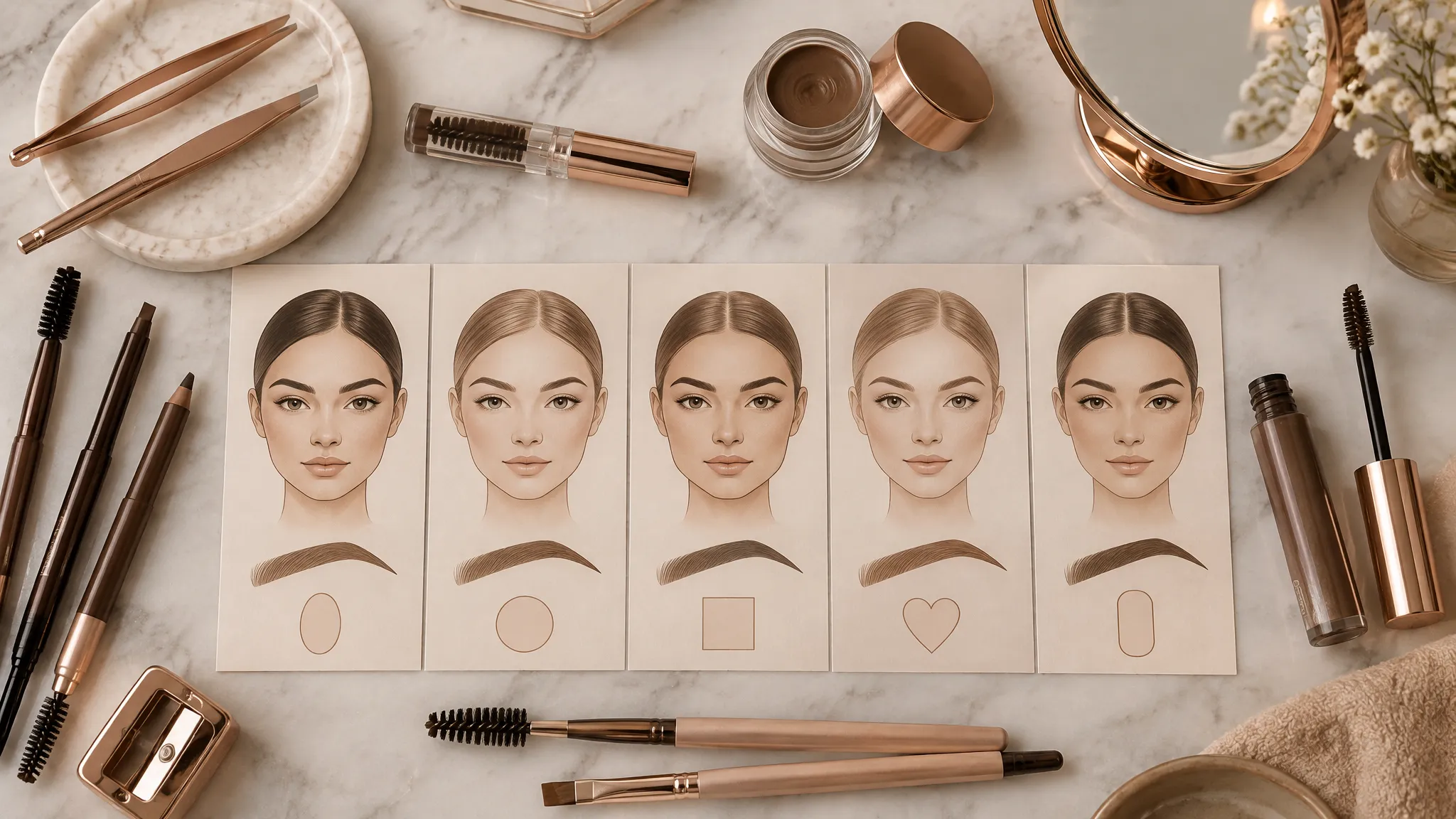
Why Your Brows Deserve More Attention Than You Think
If you've ever looked at a photo and thought something was slightly off — but couldn't pinpoint what — there's a good chance it was the eyebrows. Brows sit at the upper third of your face, the zone where the eye naturally lands first. They frame your eyes, define your expression, and quietly set the tone for every other feature around them.
I've watched clients spend hours perfecting foundation and lipstick while leaving their brows untouched or over-plucked from a trend that never suited their bone structure. The difference when you get brow shape right is immediate and dramatic. It's not about following what's popular on social media. It's about understanding how your brows interact with the geometry of your face.
Why Face Shape Matters for Brows
Your face shape is essentially a map of your proportions — how wide your forehead is compared to your jaw, how long your face is relative to its width, and where your cheekbones sit. Eyebrows are one of the few features you can reshape without surgery, and they act as a visual counterbalance to those proportions.
The principle is the same one makeup artists and brow specialists have used for decades: brows should create harmony, not competition. If your face is round and soft, a sharp angular brow might look harsh. If your face is long and narrow, a high dramatic arch can stretch things further. The goal is to nudge your visual proportions toward balance.
Research on facial attractiveness consistently shows that balanced proportions matter. Your brows won't rewrite your bone structure, but they can subtly shift how others read those proportions. Allure's brow guide has long emphasized this connection between arch placement and face shape, and in my experience, the advice holds up far more reliably than any trending brow style.
Think of your brows as horizontal lines across the top of your face. Their angle, height, and thickness all send signals about width, length, and structure. That's why the best eyebrow shape for face shape isn't a one-size-fits-all answer — it's a tailored recommendation based on what your specific proportions need.
See your personal color palette now
Upload a photo — get your AI beauty report in 60 seconds.
The 6 Face Shapes and Their Best Brow Shapes
Before we dive in, remember that these are guidelines, not rigid rules. Face shapes exist on a spectrum, and many people blend characteristics from two categories. Use this eyebrow shape guide as a starting point, then adjust based on what you see in the mirror.
Oval Face: Soft Angled Brows
Characteristics: Slightly longer than wide, with a gently curved jawline. The forehead is marginally wider than the chin, and cheekbones are typically the broadest point.
The goal: Enhance what's already balanced. Oval faces are the most versatile, so your brows should complement rather than correct.
Best brow shape: Soft angled brows with a gentle, natural arch. The peak should sit above the outer third of the iris — high enough to define, low enough to stay soft. I've found that a medium thickness with a slight upward angle at the tail creates the most polished look for oval faces.
What to avoid: Extremely thin brows that disrupt your natural harmony, or overly dramatic high arches that introduce unnecessary angularity.
Brows for oval face — quick tip: Because your proportions are already balanced, focus on grooming and symmetry rather than dramatic reshaping. A clean soft angle is all most oval faces need.
Round Face: High Arched Brows
Characteristics: Face length and width are nearly equal, with full cheeks and a soft, rounded jawline. Features tend to be curved rather than angular throughout.
The goal: Add vertical length and angular definition to counterbalance roundness and create the illusion of a more elongated face.
Best brow shape: High arched brows with a defined peak. The arch should be noticeably higher than it would be on an oval face — think of drawing the eye upward and outward. A slightly sharper angle at the highest point adds structure without looking severe.
What to avoid: Flat, horizontal brows that emphasize width, or rounded brows that mirror and amplify the roundness of your face.
Brows for round face — quick tip: Extend the tail slightly beyond where you might naturally stop. That extra length at the outer edge creates a subtle lifting effect that round faces benefit from enormously.
Square Face: Curved or Soft Rounded Brows
Characteristics: A strong, angular jawline with a forehead roughly the same width. Defined bone structure with minimal curve at the jaw.
The goal: Soften angular features while respecting the strength of your bone structure. You don't want to erase your jawline — you want to balance it.
Best brow shape: Curved brows with a soft, rounded arch rather than a sharp peak. The curve should feel organic, almost like a gentle hill rather than a pointed triangle. Medium to full thickness works well here.
What to avoid: Extremely angular brows with hard peaks — they can make an already strong face look severe. Flat brows also tend to emphasize the horizontal width of a square jaw.
Quick tip: If you have a square face and love a bold brow, lean into thickness and softness rather than height. A full, softly curved brow looks powerful and balanced on angular features.
Heart Face: Rounded or Low Arch Brows
Characteristics: A wider forehead and cheekbones that taper to a narrower, sometimes pointed chin. Often accompanied by a widow's peak or prominent upper face width.
The goal: Reduce visual emphasis on the forehead and upper face while adding a sense of width and softness at the lower third.
Best brow shape: Rounded brows with a low, gentle arch. Keep the peak soft and positioned closer to the center of the brow rather than far out toward the temple. Slightly fuller brows can help balance a wider forehead without overwhelming delicate chin features.
What to avoid: High, sharp arches that draw attention upward and exaggerate forehead width. Overly thin brows can also make the upper face look disproportionately large.
Quick tip: Avoid starting your brows too far apart. A slightly closer inner brow placement can visually narrow a wide forehead on heart-shaped faces.
Oblong (Long) Face: Flat Horizontal Brows
Characteristics: Noticeably longer than wide, with forehead, cheekbones, and jawline roughly similar in width. The face reads as elongated rather than compact.
The goal: Add horizontal width and reduce the appearance of vertical length. Your brows should interrupt the long vertical line of your face.
Best brow shape: Flat, horizontal brows with minimal arch. Keep the brow line relatively straight from inner to outer edge, with only the slightest lift at the tail. Fuller thickness helps add visual width to the upper face.
What to avoid: High arches — they are the single biggest mistake I see on oblong faces. A dramatic arch adds vertical length exactly where you least need it.
Quick tip: Resist the urge to extend the tail too far downward. A slightly extended horizontal tail, kept level rather than dipping, maintains width without adding length.
Diamond Face: Curved with a Gentle Arch
Characteristics: Narrow forehead and jawline with cheekbones as the widest point. Angular contours with prominent cheek structure.
The goal: Balance prominent cheekbones by adding softness to the brow area and creating harmony between the narrow upper and lower face.
Best brow shape: Curved brows with a gentle, medium-height arch. The arch should be rounded rather than pointed, sitting at a moderate position — not too high, not too flat. Medium fullness helps fill in the narrower forehead area.
What to avoid: Overly thin brows that make the forehead appear even narrower, or extremely flat brows that fail to provide contrast against strong cheekbones.
Quick tip: Focus on creating a smooth, continuous curve from head to tail. Diamond faces respond beautifully to brows that feel soft and fluid rather than geometric.
Face Shape Eyebrow Chart: Quick Reference
Use this face shape eyebrow chart as a cheat sheet when you're at the salon or doing your brows at home.
| Face Shape | Best Brow Shape | Arch Height | Thickness | Key Principle |
|---|---|---|---|---|
| Oval | Soft angled | Medium | Medium | Enhance natural balance |
| Round | High arched | High | Medium to full | Add length and angles |
| Square | Curved / soft rounded | Low to medium | Medium to full | Soften angular features |
| Heart | Rounded / low arch | Low | Medium to full | Balance wide forehead |
| Oblong | Flat horizontal | Minimal | Medium to full | Add width, reduce length |
| Diamond | Curved, gentle arch | Medium | Medium | Balance prominent cheekbones |
Common Eyebrow Mistakes by Face Shape
Knowing what to avoid is just as valuable as knowing what to choose. These are the mistakes I see most often — and I've made several of them myself.
Oval faces: Over-tweezing to follow a thin-brow trend. Oval faces already have balanced proportions; stripping brows down removes a natural frame that works in your favor.
Round faces: Choosing rounded, low brows because they feel "soft." Soft is good, but round-on-round creates a circular effect that widens the face. You need angles and height, not more curves.
Square faces: Going for a razor-sharp, highly angular arch to "match" strong features. The result often looks harsh. Soft curves do more work than sharp lines on square faces.
Heart faces: Starting brows too far apart or using a high arch to "open up" the eyes. Both choices push visual weight to the forehead and away from the chin, worsening the top-heavy effect.
Oblong faces: Following the high-arch trend that flatters round faces. On a long face, a high arch is like adding an exclamation point to a sentence that's already too long.
Diamond faces: Keeping brows too thin and sparse. Narrow brows on a narrow forehead make the cheekbones look even more dominant. A bit of fullness creates necessary visual balance.
One universal mistake worth mentioning: ignoring brow tail length. The tail should end on an imaginary line drawn from the outer nostril through the outer corner of the eye. Tails that fall short look unfinished; tails that dip too low add unwanted length or width depending on your face shape.
How to Determine Your Face Shape at Home
If you're not sure which category you fall into, here's a quick method I've used with clients and in my own mirror experiments.
Pull your hair back tightly — a headband or claw clip works well. Stand in front of a mirror in natural daylight, facing straight on. Use a washable marker or lipstick to trace the outline of your face on the mirror surface. Step back and look at the shape you've drawn.
Measure if you want more precision: note the widest point (forehead, cheekbones, or jaw), compare face length from hairline to chin against width at the cheekbones, and observe whether your jawline is angular or rounded.
Oval: The outline resembles an egg standing upright — wider at the cheekbones, gently tapering at both forehead and chin.
Round: The outline is nearly circular, with width and height appearing similar.
Square: The outline has straight sides and a strong horizontal jawline.
Heart: The outline is wider at the top and narrows significantly toward the chin.
Oblong: The outline is noticeably longer than it is wide, with parallel sides.
Diamond: The outline is widest at the center (cheekbones) and narrow at both top and bottom.
Take your photo from the front, not from above or below — angle distorts proportions. And give yourself grace: most people aren't a textbook example of one shape. If you're between two categories, read both sections and borrow the advice that resonates when you look in the mirror.
Modern Solutions for Getting It Right
Technology has made proportion analysis far more accessible than it was even five years ago. AI face shape analysis tools can now identify your face shape and proportions in seconds, giving you a foundation for choosing everything from brow shapes to hairstyles. I still recommend trusting your mirror and your instincts — but having an objective starting point removes a lot of the guesswork, especially if you've been unsure whether you're round, oval, or somewhere in between.
Professional brow services have also evolved. Mapping techniques used by specialists — measuring brow start, arch, and tail points relative to facial landmarks — mirror the same proportional logic this guide covers. Whether you visit a brow bar or work on your brows at home, the underlying principle remains: shape with your face, not against it.
Vogue's overview of face-framing features connects brows to hair, makeup, and accessories through the same balance-first philosophy.
Key Takeaways
- Brows frame the upper third of your face — their shape directly affects how people perceive your proportions
- The best eyebrow shape for face shape follows a balance principle: add length where you're round, add width where you're long, soften where you're angular
- Oval faces suit soft angled brows; round faces need high arches; square faces benefit from curves; heart faces need low rounded arches; oblong faces need flat horizontal brows; diamond faces need gentle curved arches
- Avoid copying trends that contradict your face shape — a brow style that flatters a round face can work against an oblong one
- Use the face shape eyebrow chart as a reference, but adjust for your unique features and preferences
- Determining your face shape at home takes five minutes with a mirror trace and makes every brow decision easier
- Thickness and grooming matter as much as arch shape — the right shape in the wrong density won't achieve the balance you're after
When your brow shape works with your face rather than fighting it, you look polished without looking overdone — and that confidence shows in every expression.
Related Articles
- How to Determine Your Face Shape in 60 Seconds — The complete face shape guide with hairstyle recommendations
- How to Choose Glasses That Flatter Your Face Shape AND Your Color Season — Extend face-shape logic to your everyday frames
- Best Earring Styles for Every Face Shape — A Visual Guide — Another accessory guide built on the same proportion principles
- Color Analysis: The Complete Guide — Everything you need to know about finding your best colors
Want to try AI color analysis yourself?
Upload one photo and get a magazine-level beauty report in 60 seconds.
Start Free Analysis