Best Earring Styles for Every Face Shape — A Visual Guide
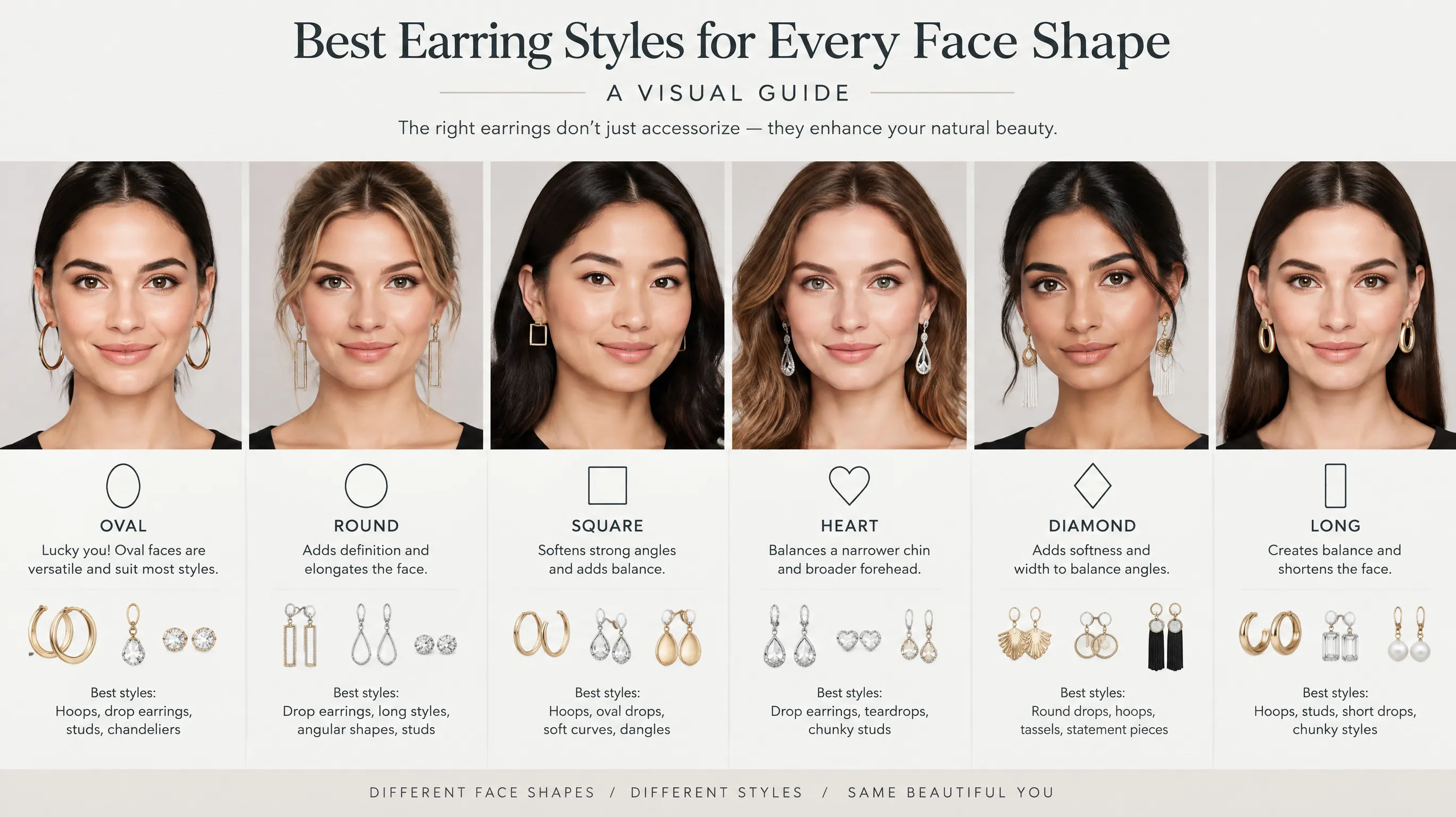
The Earring Mistake Almost Everyone Makes
Here's a confession: I spent years buying earrings based on what looked pretty on the rack. Delicate studs, dramatic chandeliers, trendy hoops — if they caught my eye, they came home with me. And half of them made me look... off. Some widened my face. Others elongated it in strange ways. A few just disappeared entirely against my features.
It took me an embarrassingly long time to realize the issue wasn't the earrings themselves. It was the relationship between the earring shape and my face shape. Once I understood that geometry — how vertical and horizontal lines interact with the contours of your face — everything changed. I stopped impulse-buying. I started choosing pieces that actually enhanced my features. And suddenly, even inexpensive earrings looked like they were made for me.
This guide breaks down exactly which earring styles complement each face shape, and more importantly, why they work. Because once you understand the logic, you'll never second-guess an earring purchase again.
Why Face Shape Matters for Earrings
Earrings sit at the widest, most visible point of your face — right at the jawline and cheekbone intersection. Unlike a necklace (which frames your neck) or a ring (which is far from your face), earrings directly alter the perceived proportions of your facial structure.
The core principle is simple: earrings should create balance. If your face is wide, you want earrings that add length. If your face is long, you want earrings that add width. If your face is already balanced (like an oval), you have the widest range of options.
According to research published in Perception journal, people perceive faces as more attractive when their proportions approach a balanced oval ratio — roughly 1.6:1 (length to width). Earrings are one of the easiest tools for nudging your visual proportions in that direction.
Here's another thing most guides won't tell you: scale matters as much as shape. A petite face overwhelmed by massive chandelier earrings won't look balanced regardless of face shape. I'll cover sizing recommendations for each shape too.
See your personal color palette now
Upload a photo — get your AI beauty report in 60 seconds.
How to Determine Your Face Shape
Before diving into recommendations, let's make sure you know your face shape. Pull your hair back, face a mirror straight on, and observe:
- Oval: Face is longer than wide, forehead slightly wider than jaw, cheekbones are the widest point, jawline gently rounded
- Round: Face length and width are nearly equal, fullest at the cheeks, soft jawline with no sharp angles
- Square: Strong, angular jawline approximately the same width as forehead, face width and length are similar
- Heart (inverted triangle): Wide forehead and cheekbones, narrow chin that may come to a point
- Oblong (rectangle): Face is noticeably longer than wide, forehead/cheekbones/jaw are roughly similar in width
- Diamond: Narrow forehead and jawline, cheekbones are the widest point, face has angular contours
If you're unsure, try tracing your face outline on a mirror with a washable marker — the shape becomes immediately obvious. Or you can use an AI face shape analysis tool that identifies your shape from a photo and provides personalized recommendations.
Best Earrings for Oval Faces
Why you're lucky: The oval face is the most proportionally balanced shape, which means almost any earring style works. Your job isn't to correct proportions — it's to enhance and highlight what's naturally balanced.
Best styles:
- Teardrop and drop earrings — Follow the natural contour of your face beautifully
- Oval hoops — Echo your face shape for harmonious repetition
- Studs in medium sizes — Keep the balance without overwhelming
- Chandelier earrings — Add drama without disrupting proportions
- Geometric shapes — Angular earrings add interesting contrast to your soft contours
Be cautious with:
- Extremely long, narrow earrings that could over-elongate your already balanced proportions
- Overly large pieces that overpower rather than complement
Sizing guide: You can go medium to large confidently. Your proportions can handle statement pieces that other shapes might not be able to pull off.
My go-to pick for oval faces: A medium-length teardrop earring. It follows your face's natural taper and adds just enough movement to catch the light. Whether you go for gold or silver depends on your skin undertone — not your face shape.
Best Earrings for Round Faces
The goal: Add vertical length and angular contrast to counterbalance the width and softness of a round face.
Best styles:
- Long drop earrings — The vertical line creates a slimming visual effect
- Angular dangles — Rectangles, elongated triangles, and geometric linear drops add structure
- Threader earrings — The ultimate face-lengthener; delicate chains that hang through the earlobe
- Narrow hoops (elongated or oval) — Vertical-oriented hoops that draw the eye downward
- Tapered earrings — Anything wider at top and narrower at bottom helps elongate
Avoid:
- Round studs and button earrings — They echo and emphasize facial roundness
- Wide hoops — Add horizontal width exactly where you don't need it
- Circular, coin-shaped dangles — Same round-on-round repetition
Sizing guide: Go longer rather than wider. A 2-3 inch drop earring works beautifully. If studs are your thing, choose angular shapes (square, bar, or diamond-shaped) over circles.
The exception: If you want to emphasize your round face's youthful, approachable quality (which is a perfectly valid choice), small round studs and gentle hoops actually enhance that aesthetic. Rules are guidelines, not laws.
Best Earrings for Square Faces
The goal: Soften the strong jawline and angular structure with curves and rounded shapes.
Best styles:
- Round hoops — Soften the angles of a square jaw beautifully
- Circular studs — Introduce curves near the angular jawline
- Curved drop earrings — Soft, flowing shapes that contrast with sharp features
- Medium-length dangles with rounded ends — Add length while introducing softness
- Teardrop shapes — The tapered curve softens without over-elongating
Avoid:
- Square or rectangular earrings — They mirror and emphasize your angular jaw
- Harsh geometric shapes — Sharp triangles, pointed designs, and boxy structures double down on angularity
- Very short, wide studs — They draw attention to jawline width
Sizing guide: Medium is your sweet spot. Nothing too small (it gets lost against a strong jaw) or too large (it competes with your naturally bold bone structure). If you have a defined jawline, you can handle slightly bolder pieces than you might expect.
Styling trick: Hoop earrings that sit at or just below the jawline create a beautiful visual interruption that softens the jaw's horizontal line. The hoop's curve "breaks" the straight edge in the most flattering way.
Best Earrings for Heart-Shaped Faces
The goal: Add visual weight near the jawline and chin to balance the wider forehead. Earrings that are wider at the bottom than the top work wonders.
Best styles:
- Chandelier earrings — Wide at the bottom, they add fullness exactly where a heart face needs it
- Teardrop earrings (inverted) — Wider at the bottom, narrower at top
- Fan-shaped or paddle earrings — Width at jawline level creates balance
- Bottom-heavy dangles — Any design that's heavier or wider toward the end
- Small-to-medium hoops at jaw level — Fill out the narrow lower face
Avoid:
- Top-heavy earrings — Anything wider at the top adds width to your already wide forehead
- Large studs — They draw attention to the widest part of your face (cheekbones and temples)
- Narrow, pointed earrings — They mimic your chin's point, exaggerating the taper
- Inverted triangle shapes — They literally duplicate your face shape
Sizing guide: Medium to large works well, especially if the volume is concentrated at the bottom. Think statement pieces that "fill in" the jawline area.
A clever hack: If you love studs but have a heart face, choose studs with a dangling element — a small charm or chain hanging below. You get the ease of a stud with the balancing effect of a drop.
Best Earrings for Oblong (Rectangle) Faces
The goal: Add width and visual "breaks" to shorten the perceived length of a long face. Horizontal elements are your best friend.
Best styles:
- Round studs — They widen the face and keep everything compact
- Wide hoops — Add horizontal dimension right at the cheekbone
- Cluster earrings — Multiple stones or elements create width and visual fullness
- Button earrings — Sit close to the face and add width without length
- Short, wide dangles — Earrings that extend outward rather than downward
- Ear cuffs and climbers — Add interest without adding length below the earlobe
Avoid:
- Long, narrow drops — They extend the vertical line even further
- Linear, shoulder-grazing earrings — The last thing a long face needs is more length
- Thin chains or threaders — Too elongating
- Very small studs — They get lost and don't contribute the width you need
Sizing guide: Think wide, not long. A 1-inch diameter hoop is better than a 2-inch linear drop. If you do wear dangles, keep them short and choose styles that extend sideways.
My favorite trick for oblong faces: Layered ear piercings. If you have multiple piercings, stacking small studs and huggies up the ear creates horizontal interest that beautifully counterbalances length.
Best Earrings for Diamond Faces
The goal: Soften the angular cheekbones (the widest point) and add width near the forehead and jaw. This shape benefits from earrings that are wider at the top or bottom — anything that balances those prominent cheekbones.
Best styles:
- Linear drop earrings — Draw the eye vertically past the cheekbones
- Curved, narrow dangles — Elongate without adding width at the cheekbone
- Small-to-medium studs — Keep things subtle at ear level (where your face is widest)
- Teardrop earrings — Add softness below the angular cheekbone
- Ear jackets — The front-and-back design adds dimension without widening
Avoid:
- Wide earrings at cheekbone level — They exaggerate the widest point
- Large hoops — Add width where your face is already widest
- Pointed, angular shapes — They echo the diamond's sharp angles
Sizing guide: Medium length, narrow to medium width. The goal is to not add bulk at the midpoint of your face. Earrings that have visual weight above or below cheekbone level work best.
The Material Factor: Beyond Shape
Shape gets the most attention, but material and finish matter too:
Matte vs. shiny: Matte finishes are more subtle and recessive; shiny metals catch light and draw more attention. If you want your earrings to gently enhance your shape, go matte. If you want them to be a focal point, go polished.
Weight and movement: Heavier earrings pull the earlobe down, effectively lengthening the earring's visual impact. Factor this in — a lightweight chandelier sits differently than a heavy one.
Color and skin tone: Your face shape determines the earring shape, but your undertone determines the earring metal. These are two separate decisions:
- Warm undertones → gold, brass, copper, warm rose gold
- Cool undertones → silver, platinum, white gold, cool-toned metals
- Neutral undertones → you can wear either
For a deeper dive into metal selection, check out my complete guide to jewelry metals and skin tone.
Practical Shopping Tips
After years of earring trial-and-error, here are the shortcuts I wish someone had told me:
-
Take a selfie, not a mirror glance. Mirrors reverse your image. A front-facing photo shows you what others actually see, and it's easier to evaluate proportions.
-
Hold earrings next to your face before buying. Even if you can't try them on, holding them at ear level gives you a preview.
-
Buy one "perfect pair" before building a collection. Find the shape that objectively works for your face, then invest in a quality pair. Once you have your anchor shape, experiment from there.
-
Consider your hairstyle. Hair up? Your earrings become the primary frame for your face — shape matching matters most. Hair down? Earrings interact with your hair as much as your face, and you can be more flexible.
-
Don't forget about your glasses. If you wear glasses daily, your earrings need to harmonize with your frames too. I wrote a full guide on choosing glasses for your face shape that covers this interaction.
A Quick Reference Chart
| Face Shape | Best Styles | Avoid | Key Principle |
|---|---|---|---|
| Oval | Teardrops, hoops, studs, chandeliers | Very long narrow drops | Almost anything works |
| Round | Long drops, angular dangles, threaders | Round studs, wide hoops | Add length, add angles |
| Square | Round hoops, curved drops, teardrops | Square/rectangular shapes | Soften with curves |
| Heart | Chandeliers, bottom-heavy drops | Top-heavy earrings, large studs | Add width at jaw level |
| Oblong | Round studs, wide hoops, clusters | Long narrow drops | Add width, reduce length |
| Diamond | Linear drops, narrow dangles, small studs | Wide earrings at cheekbone level | Balance the cheekbones |
Key Takeaways
- Earrings are a proportioning tool, not just decoration — they alter how others perceive your face shape
- The core rule is balance: add what your face shape lacks (length, width, curves, or angles)
- Shape and metal are separate decisions — your face shape picks the earring style, your undertone picks the metal
- Scale matters as much as style — the right shape in the wrong size won't create balance
- Hairstyle changes the equation — the same face with hair up vs. down may suit different earring styles
- Rules are starting points, not limits — understanding why certain shapes work gives you the confidence to break rules intentionally
The best part about understanding face shape and earring geometry? It works at every price point. A $12 pair of earrings in the right shape for your face will look more polished and intentional than a $200 pair in the wrong shape. That's the power of knowing your proportions.
Related Articles
- How to Choose Glasses Frames That Actually Flatter Your Face Shape — Another face-shape-based accessory guide
- Gold or Silver? How Your Skin Undertone Determines Your Best Metal — Pair the right shape with the right metal
- How to Accessorize Based on Your Color Season — Extend your accessory strategy beyond earrings
- How to Determine Your Face Shape in 60 Seconds — The complete face shape guide with hairstyle recommendations
Want to try AI color analysis yourself?
Upload one photo and get a magazine-level beauty report in 60 seconds.
Start Free Analysis