Verano frío vs Verano suave
Cool Summer and Soft Summer are the two most common Summer misidentifications. Both are cool-leaning with muted qualities, but Cool Summer is a true cool type with medium chroma, while Soft Summer is the most muted Summer with the lowest contrast. Cool Summer is clearer; Soft Summer is dustier.
Diferencias clave
| Dimension | Verano frío | Verano suave |
|---|---|---|
| Undertone | Strongly cool (blue, pink, rosy) | Cool-neutral (cool but handles slightly warm muted tones) |
| Depth | Medium — balanced depth, not extreme | Medium — neither very light nor very dark |
| Chroma | Medium — slightly muted but not dusty | Low — distinctly muted, soft, and dusty |
| Contrast | Medium — some distinction between features | Low — features blend together softly |
Cómo distinguirlas
- →Cool Summer can wear medium-depth cool colors like teal and berry; Soft Summer needs everything dustier.
- →Soft Summer is the most blended, harmonious Summer; Cool Summer has slightly more definition.
- →Raspberry and steel blue flatter Cool Summer; dusty rose and sage green flatter Soft Summer.
- →If vivid cool colors feel too strong, you are likely Soft Summer; Cool Summer wears them well.
Comparación de paletas de color
Mira las muestras de color reales lado a lado. Observa cómo una paleta tiende a lo cálido y la otra a lo frío, aunque compartan profundidad o suavidad similares.
Verano frío
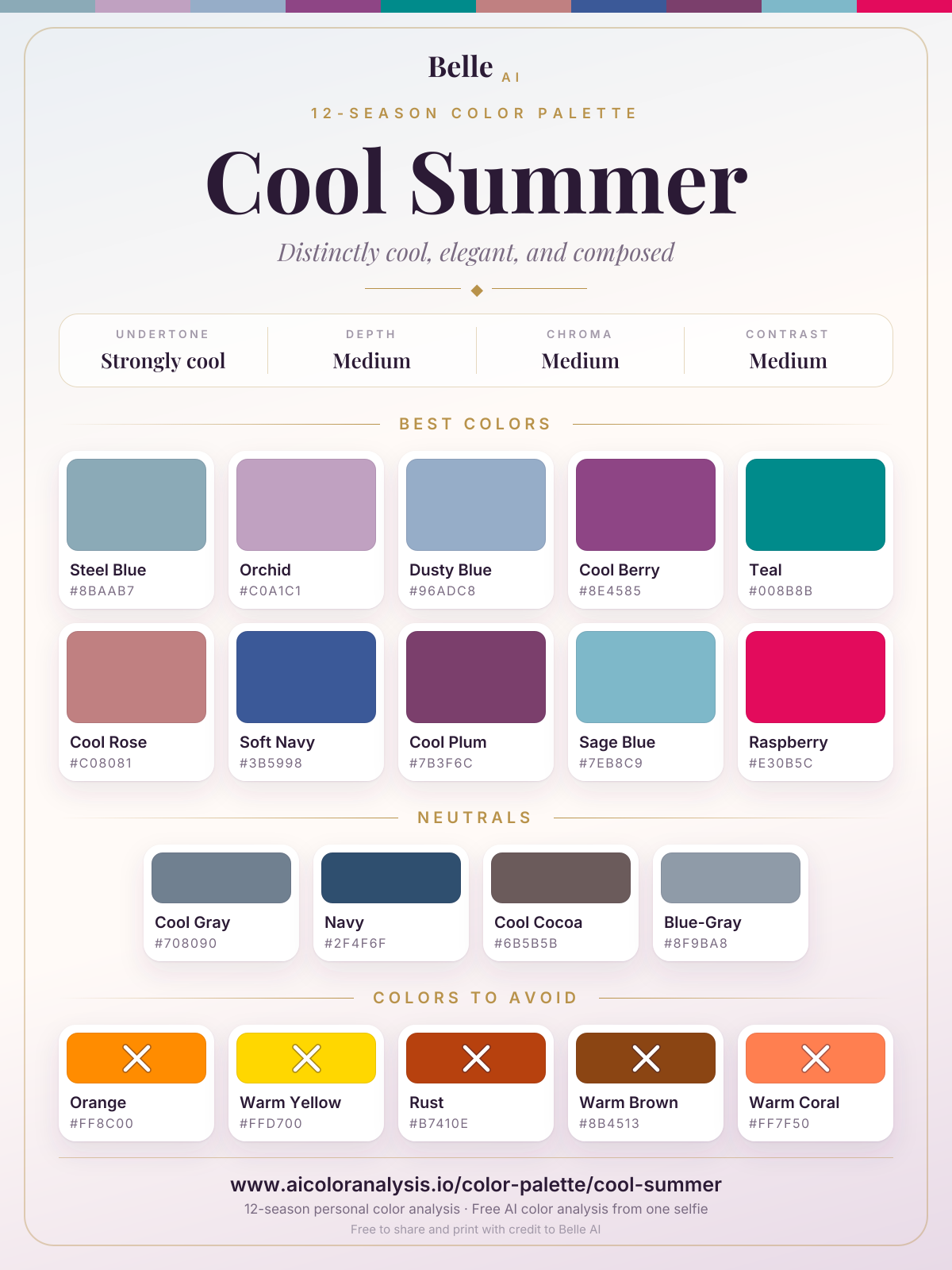
- Azul acero #8BAAB7
- Orquídea #C0A1C1
- Azul apagado #96ADC8
- Baya fría #8E4585
- Verde azulado #008B8B
- Rosa frío #C08081
- Azul marino suave #3B5998
- Ciruela fría #7B3F6C
- Azul salvia #7EB8C9
- Frambuesa #E30B5C
Verano suave
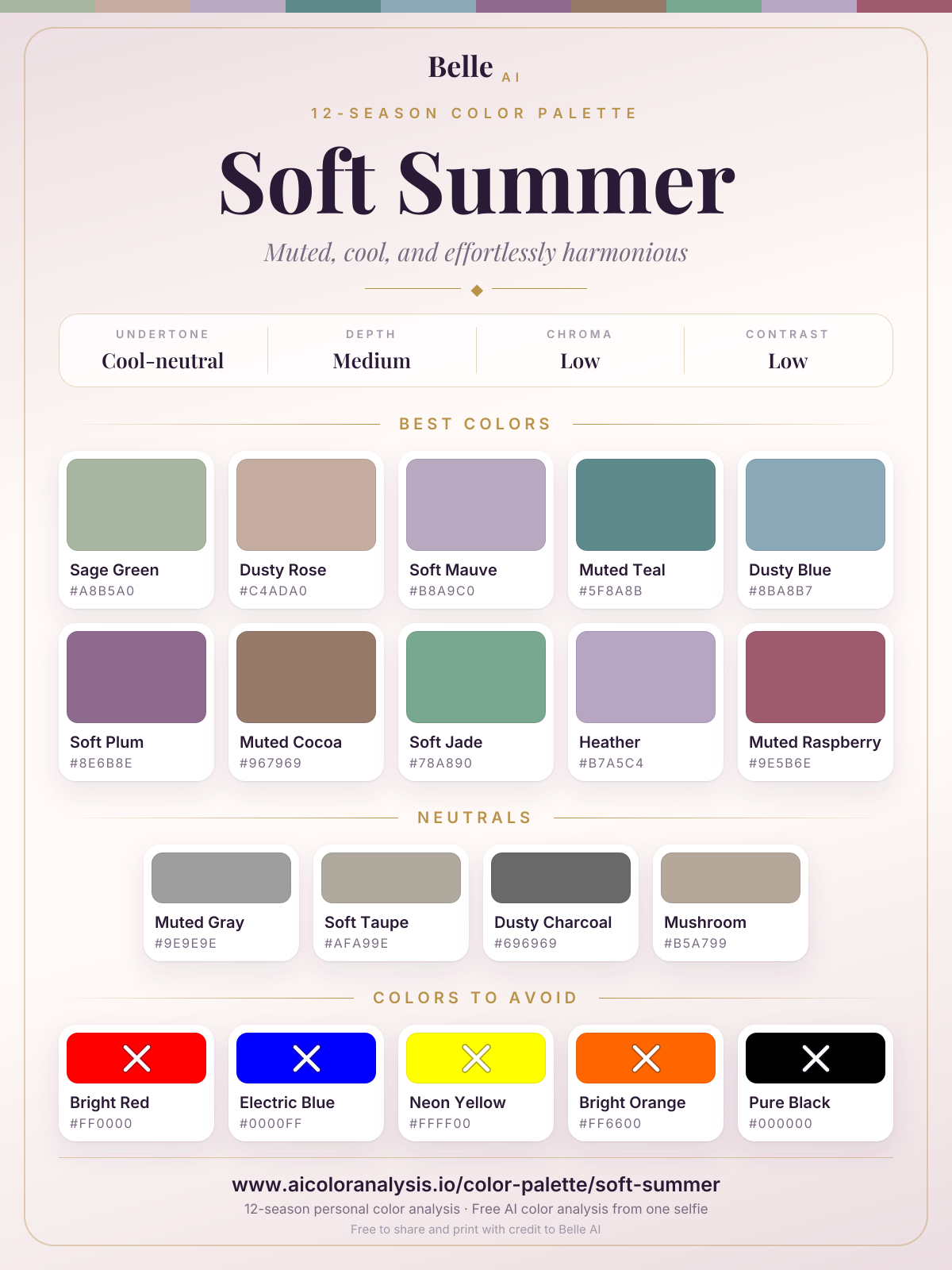
- Verde salvia #A8B5A0
- Rosa apagado #C4ADA0
- Malva suave #B8A9C0
- Verde azulado apagado #5F8A8B
- Azul apagado #8BA8B7
- Ciruela suave #8E6B8E
- Cacao apagado #967969
- Jade suave #78A890
- Brezo #B7A5C4
- Frambuesa apagada #9E5B6E
Errores comunes al determinar el tipo
Estos son los errores más frecuentes al intentar determinar si eres Verano frío o Verano suave.
- ⚠Believing both types are 'just muted and cool' — the difference in saturation tolerance is significant. Cool Summer has notably more chroma than Soft Summer
- ⚠Typing as Soft Summer because muted colors feel safe — comfort doesn't equal best match. Cool Summer may prefer muted out of habit but actually looks better in slightly bolder cool tones
- ⚠Using the warm/cool binary alone: both are cool, so the warm-cool test won't differentiate them. Focus on saturation and contrast instead
Prueba de drapeado casera
Prueba esta comparación de colores en casa para saber qué estación se ajusta a tu coloración natural. Hazla con luz natural junto a una ventana y sin maquillaje.
The saturation comparison: hold a medium-depth raspberry (moderately saturated, cool) and a dusty sage (very muted, slightly cool) against your face. Cool Summer's skin becomes clear and defined with the raspberry — there's enough saturation to match their coloring. Soft Summer is overwhelmed by raspberry but perfectly harmonious with the dusty sage — it matches their low-saturation nature. Both look acceptable in muted mauve, but only Cool Summer also handles berry and teal.
Comparación de colores en la vida real
Esto es lo que ocurre cuando cada tipo lleva el mismo color cotidiano: la diferencia muestra por qué importa conocer tu estación.
Both types wearing a teal blazer to a meeting: Cool Summer looks sharp, professional, and 'together' — the medium-saturation cool color matches their contrast level. Soft Summer looks slightly over-dressed or out of character — the teal's saturation exceeds their natural muting. Soft Summer swaps for a mushroom-gray blazer and immediately looks polished and natural. Cool Summer in the same mushroom-gray looks unremarkable and slightly drained of their natural coolness.
Explora cada paleta de color
Preguntas frecuentes — Verano frío vs Verano suave
What is the difference between Cool Summer and Soft Summer?
Both are cool-leaning Summers, but Cool Summer is a true cool type with medium chroma and moderate contrast, while Soft Summer is the most muted Summer with the lowest contrast. Cool Summer is clearer; Soft Summer is dustier and more blended.
Is Soft Summer the same as Cool Summer?
No. Soft Summer is the most muted of all 12 seasons with very low chroma, while Cool Summer has medium chroma and can wear clearer cool colors like teal, steel blue, and raspberry. Soft Summer needs everything in dusty, muted versions.
How do I know if I am Cool Summer or Soft Summer?
If medium-depth cool colors like teal and berry look great on you, you are likely Cool Summer. If only the dustiest, most muted cool tones work and vivid colors of any kind overwhelm you, you are likely Soft Summer.
¿No sabes qué estación eres?
Sube una foto para un análisis de color personal con IA. Descubre tu tipo exacto entre las 12 estaciones y recibe recomendaciones de paleta, maquillaje y vestuario.
Otras comparaciones de estaciones
Otoño suave vs Verano suave
Soft Autumn and Soft Summer are the two most commonly confused sub-seasons in color analysis. Both are muted and low-contrast, which makes them look similar in photos and draping tests. The critical difference is undertone: Soft Autumn leans warm while Soft Summer leans cool.
Primavera clara vs Verano claro
Light Spring and Light Summer share the same light, delicate overall coloring and low contrast. Many fair-skinned people with light hair bounce between these two types. The deciding factor is undertone: Light Spring has a warm golden glow, while Light Summer has a cool pink or rosy quality.
Primavera cálida vs Otoño cálido
Warm Spring and Warm Autumn are both strongly warm, which causes frequent misclassification. The key distinction is chroma and depth: Warm Spring is clear, bright, and medium in depth, while Warm Autumn is richer, deeper, and more muted. Think sunny vibrancy versus earthy richness.
Primavera brillante vs Invierno brillante
Bright Spring and Bright Winter are the two highest-chroma types in the 12-season system. Both have vivid, clear coloring and high contrast, which makes them easy to confuse. Bright Spring has warm undertones and tolerates warm-leaning brights, while Bright Winter is cool-neutral and needs icy clarity.
Verano frío vs Invierno frío
Cool Summer and Cool Winter are both distinctly cool, but they sit at opposite ends of depth and contrast. Cool Summer is medium-depth with moderate contrast and slightly muted coloring, while Cool Winter is bold, high-contrast, and saturated. Many cool-toned brunettes debate between these two.
Otoño profundo vs Invierno profundo
Deep Autumn and Deep Winter are the two darkest, most dramatic sub-seasons. Both have deep coloring and high contrast, which makes them frequently confused — especially for people with dark hair and medium-to-deep skin. Deep Autumn is warm-neutral; Deep Winter is cool-neutral.
Otoño suave vs Otoño cálido
Soft Autumn and Warm Autumn both belong to the Autumn family and share warm undertones. The confusion arises because both look good in earthy tones. Soft Autumn is muted and low-contrast, while Warm Autumn is richer, more saturated, and medium-deep with more visible warmth.
Primavera clara vs Primavera brillante
Light Spring and Bright Spring are both in the Spring family with warm undertones, but they differ sharply in contrast and chroma. Light Spring is delicate, light, and low-contrast, while Bright Spring is vivid, clear, and high-contrast. Fair-skinned Springs often misidentify between these two.
Otoño profundo vs Otoño suave
Deep Autumn and Soft Autumn share warm undertones but sit at opposite ends of depth and contrast within the Autumn family. Deep Autumn is dark, rich, and high-contrast, while Soft Autumn is muted, gentle, and low-contrast. People with medium warm coloring often land between these two.
Invierno profundo vs Invierno frío
Deep Winter and Cool Winter are both cool Winters with high contrast, but they differ in depth. Deep Winter is the darkest Winter type with very deep overall coloring, while Cool Winter is the true cool type at medium-deep depth. Dark-haired cool-toned people often debate between these two.
Invierno brillante vs Invierno frío
Bright Winter and Cool Winter are both cool Winters, but Bright Winter has the highest chroma and contrast of any type, while Cool Winter is the pure cool expression with bold but not necessarily vivid coloring. The confusion is common among people with dark hair, fair skin, and striking eyes.
Primavera cálida vs Primavera clara
Warm Spring and Light Spring are both warm Springs, but Warm Spring is the true, saturated Spring with medium depth and contrast, while Light Spring is the lightest and most delicate Spring with low contrast. Golden fair-skinned people frequently confuse these two.
Otoño cálido vs Otoño profundo
Warm Autumn and Deep Autumn are both warm Autumn types, but Warm Autumn is the true Autumn with medium-deep richness, while Deep Autumn adds Winter depth and high contrast. People with warm dark hair and medium-to-deep skin often struggle to choose between them.
Verano claro vs Verano frío
Light Summer and Cool Summer are both cool Summers, but Light Summer is the lightest and most delicate with very low contrast, while Cool Summer is the true Summer at medium depth with moderate contrast. Fair cool-toned people often misidentify between these two.