Guide de l'analyse colorimétrique
Automne doux vs Automne chaud
Soft Autumn and Warm Autumn both belong to the Autumn family and share warm undertones. The confusion arises because both look good in earthy tones. Soft Autumn is muted and low-contrast, while Warm Autumn is richer, more saturated, and medium-deep with more visible warmth.
Principales différences
| Dimension | Automne doux | Automne chaud |
|---|---|---|
| Undertone | Warm-neutral (gentle, sun-faded warmth) | Strongly warm (golden, bronze) |
| Depth | Medium — balanced, not extreme | Medium-deep — rich overall coloring |
| Chroma | Low — distinctly soft and muted | Medium — saturated but not vivid |
| Contrast | Low — features close in depth and intensity | Medium — warm harmony with depth variation |
Comment les distinguer
- →Soft Autumn looks best in dusty coral and warm taupe; Warm Autumn in burnt orange and rust.
- →Vivid warm colors overwhelm Soft Autumn but energize Warm Autumn.
- →Soft Autumn has a gentle, blended appearance; Warm Autumn has richer, more defined warmth.
- →Camel and sage are Soft Autumn staples; terracotta and mustard are Warm Autumn power colors.
Comparaison des palettes de couleurs
Comparez les nuanciers côte à côte. Remarquez comment l'une des palettes tire vers le chaud et l'autre vers le froid, même à profondeur ou douceur similaires.
Automne doux
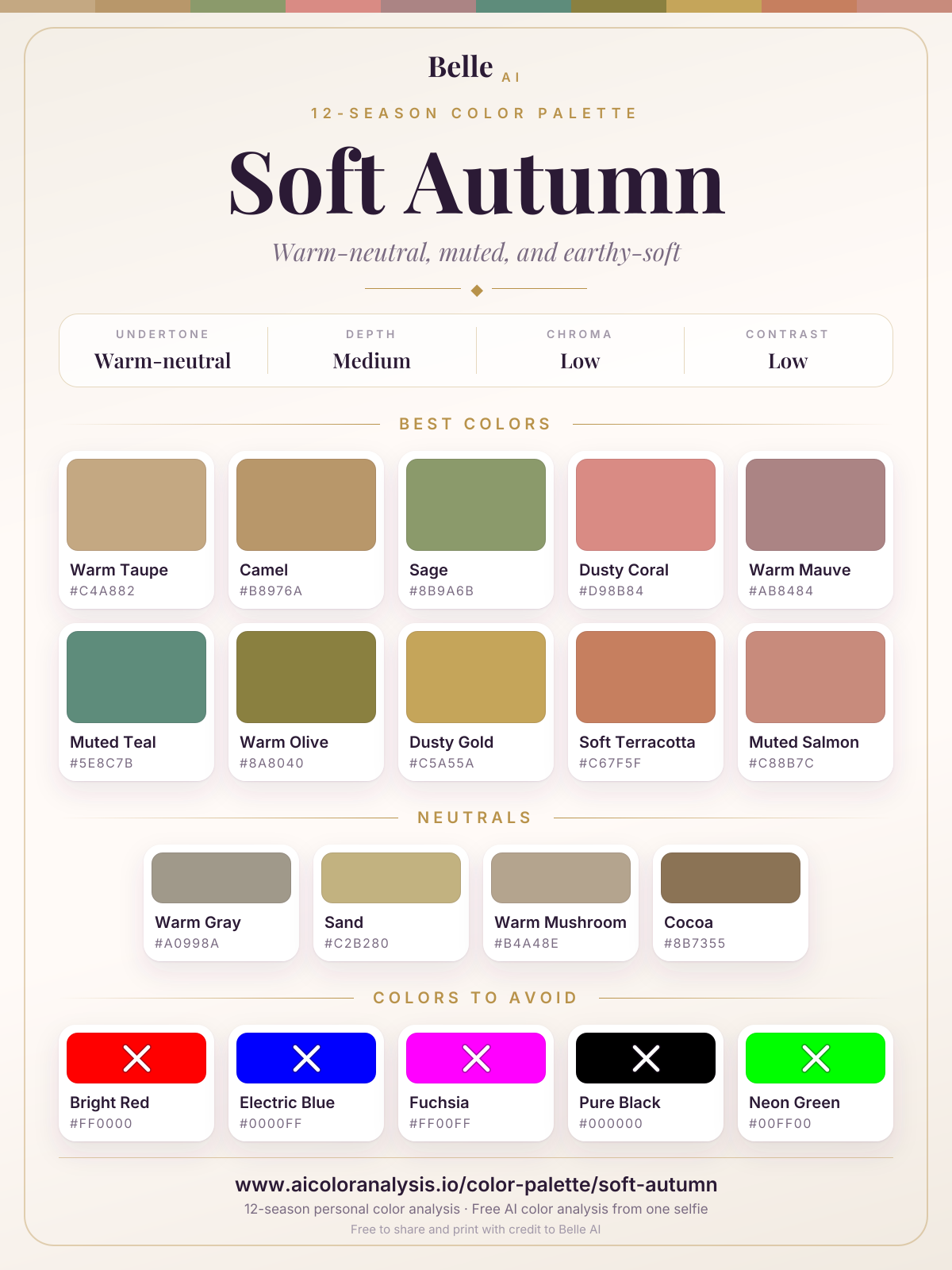
- Taupe chaud #C4A882
- Camel #B8976A
- Sauge #8B9A6B
- Corail poussiéreux #D98B84
- Mauve chaud #AB8484
- Bleu-vert muted #5E8C7B
- Olive chaude #8A8040
- Or poussiéreux #C5A55A
- Terre cuite douce #C67F5F
- Saumon muted #C88B7C
Automne chaud
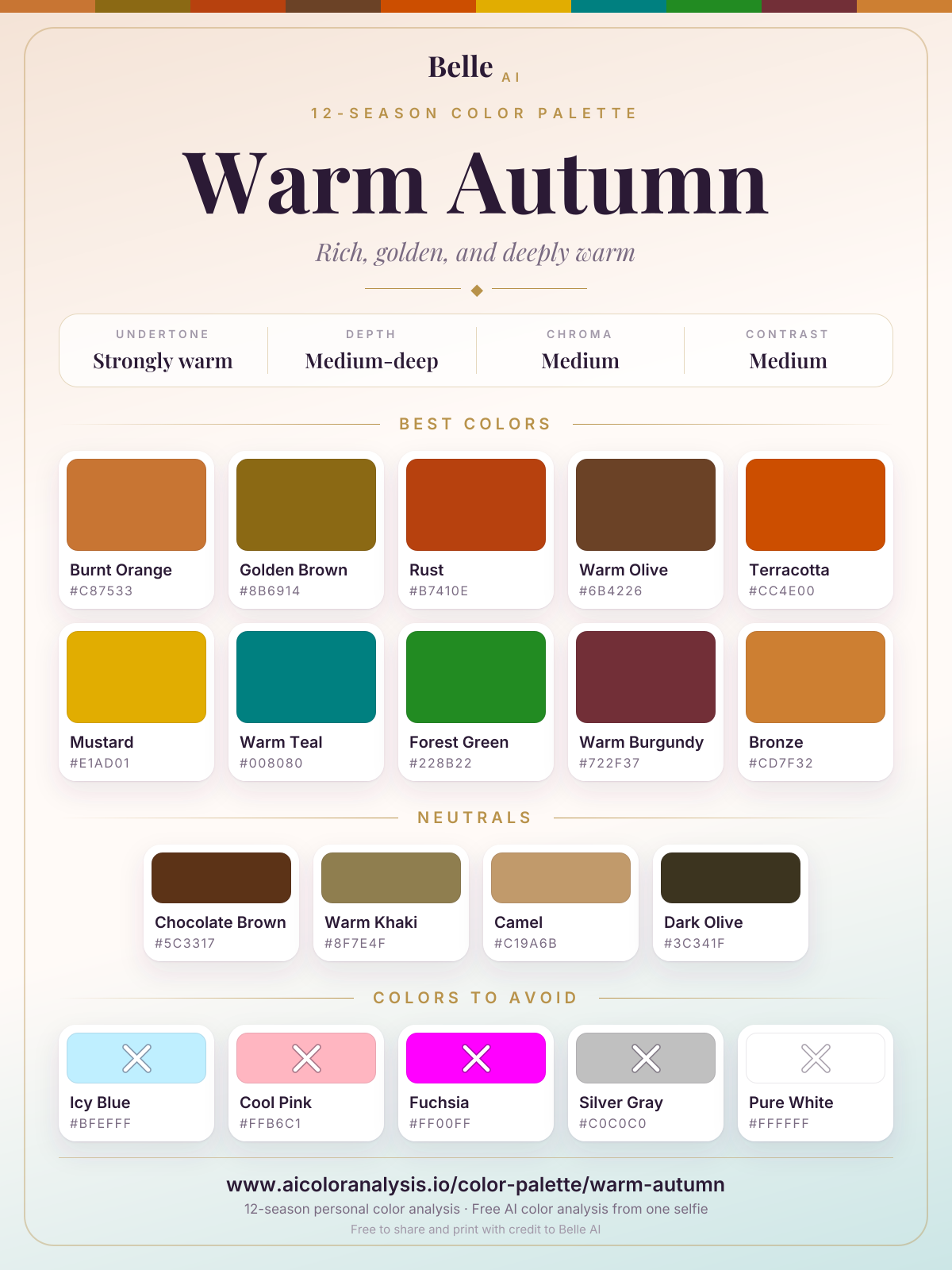
- Orange brûlé #C87533
- Brun doré #8B6914
- Rouille #B7410E
- Olive chaude #6B4226
- Terre cuite #CC4E00
- Moutarde #E1AD01
- Bleu-vert chaud #008080
- Vert forêt #228B22
- Bordeaux chaud #722F37
- Bronze #CD7F32
Erreurs courantes de typage
Voici les erreurs les plus fréquentes lorsqu'on cherche à savoir si l'on est Automne doux ou Automne chaud.
- ⚠Thinking 'Autumn = all the same' — the difference between muted and saturated warm tones dramatically affects which specific shades flatter you
- ⚠Assuming tanned skin means Warm Autumn — Soft Autumns also tan warmly but their natural coloring is gentler and lower-contrast even when tan
- ⚠Typing based on personality: the 'bold' Autumn feels like Warm Autumn, but color typing is about physical coloring, not personal style preferences
Test de drapage à faire soi-même
Essayez cette comparaison de couleurs chez vous pour savoir quelle saison correspond à votre carnation naturelle. Faites-la à la lumière du jour près d'une fenêtre, sans maquillage.
The saturation test: hold a bright mustard yellow and a muted sage green against your face. Warm Autumn lights up in the mustard — it matches their saturated warmth. Soft Autumn is overwhelmed by the vivid mustard but looks naturally elegant in sage. For a second test, try a bold terracotta vs muted warm taupe: Warm Autumn can carry the bold terracotta; Soft Autumn looks more harmonious in the gentler warm taupe.
Comparaison en situation réelle
Voici ce qui se passe quand chaque type porte la même couleur du quotidien : la différence montre pourquoi connaître sa saison est important.
Both types trying on a bright burnt orange coat: Warm Autumn looks powerful and stylish — the saturated warmth and depth feel balanced against their richer coloring. Soft Autumn looks like the coat is wearing them — the color intensity is too high and creates an unbalanced, costume-like effect. Soft Autumn picks up a dusty camel coat instead and suddenly looks polished and put-together, while the same camel feels bland and underwhelming on Warm Autumn.
Découvrez chaque palette de couleurs
FAQ — Automne doux vs Automne chaud
How are Soft Autumn and Warm Autumn different?
Both are warm Autumns, but Soft Autumn is muted and low-contrast with gentle, sun-faded warmth, while Warm Autumn is richer, more saturated, and medium-deep with strong golden-bronze warmth. Soft Autumn is subtle; Warm Autumn is rich.
Can Soft Autumn wear Warm Autumn colors?
Vivid warm colors like burnt orange, rust, and mustard will overwhelm Soft Autumn's muted coloring. Soft Autumn should stick to dusty coral, warm taupe, camel, and sage. Warm Autumn can handle the richer, more saturated warm tones.
Which Autumn type am I if I look good in earth tones?
If muted earth tones like warm taupe and sage look best, you are Soft Autumn. If rich earth tones like terracotta, rust, and mustard energize you, you are Warm Autumn. Test a dusty coral (Soft Autumn) vs burnt orange (Warm Autumn) to confirm.
Vous ne savez pas quelle saison vous êtes ?
Téléchargez une photo pour une analyse colorimétrique personnelle par IA. Découvrez votre type exact parmi les 12 saisons et recevez des recommandations de palette, de maquillage et de garde-robe.
Autres comparaisons de saisons
Automne doux vs Été doux
Soft Autumn and Soft Summer are the two most commonly confused sub-seasons in color analysis. Both are muted and low-contrast, which makes them look similar in photos and draping tests. The critical difference is undertone: Soft Autumn leans warm while Soft Summer leans cool.
Printemps clair vs Été clair
Light Spring and Light Summer share the same light, delicate overall coloring and low contrast. Many fair-skinned people with light hair bounce between these two types. The deciding factor is undertone: Light Spring has a warm golden glow, while Light Summer has a cool pink or rosy quality.
Printemps chaud vs Automne chaud
Warm Spring and Warm Autumn are both strongly warm, which causes frequent misclassification. The key distinction is chroma and depth: Warm Spring is clear, bright, and medium in depth, while Warm Autumn is richer, deeper, and more muted. Think sunny vibrancy versus earthy richness.
Printemps vif vs Hiver vif
Bright Spring and Bright Winter are the two highest-chroma types in the 12-season system. Both have vivid, clear coloring and high contrast, which makes them easy to confuse. Bright Spring has warm undertones and tolerates warm-leaning brights, while Bright Winter is cool-neutral and needs icy clarity.
Été froid vs Hiver froid
Cool Summer and Cool Winter are both distinctly cool, but they sit at opposite ends of depth and contrast. Cool Summer is medium-depth with moderate contrast and slightly muted coloring, while Cool Winter is bold, high-contrast, and saturated. Many cool-toned brunettes debate between these two.
Automne profond vs Hiver profond
Deep Autumn and Deep Winter are the two darkest, most dramatic sub-seasons. Both have deep coloring and high contrast, which makes them frequently confused — especially for people with dark hair and medium-to-deep skin. Deep Autumn is warm-neutral; Deep Winter is cool-neutral.
Printemps clair vs Printemps vif
Light Spring and Bright Spring are both in the Spring family with warm undertones, but they differ sharply in contrast and chroma. Light Spring is delicate, light, and low-contrast, while Bright Spring is vivid, clear, and high-contrast. Fair-skinned Springs often misidentify between these two.
Été froid vs Été doux
Cool Summer and Soft Summer are the two most common Summer misidentifications. Both are cool-leaning with muted qualities, but Cool Summer is a true cool type with medium chroma, while Soft Summer is the most muted Summer with the lowest contrast. Cool Summer is clearer; Soft Summer is dustier.
Automne profond vs Automne doux
Deep Autumn and Soft Autumn share warm undertones but sit at opposite ends of depth and contrast within the Autumn family. Deep Autumn is dark, rich, and high-contrast, while Soft Autumn is muted, gentle, and low-contrast. People with medium warm coloring often land between these two.
Hiver profond vs Hiver froid
Deep Winter and Cool Winter are both cool Winters with high contrast, but they differ in depth. Deep Winter is the darkest Winter type with very deep overall coloring, while Cool Winter is the true cool type at medium-deep depth. Dark-haired cool-toned people often debate between these two.
Hiver vif vs Hiver froid
Bright Winter and Cool Winter are both cool Winters, but Bright Winter has the highest chroma and contrast of any type, while Cool Winter is the pure cool expression with bold but not necessarily vivid coloring. The confusion is common among people with dark hair, fair skin, and striking eyes.
Printemps chaud vs Printemps clair
Warm Spring and Light Spring are both warm Springs, but Warm Spring is the true, saturated Spring with medium depth and contrast, while Light Spring is the lightest and most delicate Spring with low contrast. Golden fair-skinned people frequently confuse these two.
Automne chaud vs Automne profond
Warm Autumn and Deep Autumn are both warm Autumn types, but Warm Autumn is the true Autumn with medium-deep richness, while Deep Autumn adds Winter depth and high contrast. People with warm dark hair and medium-to-deep skin often struggle to choose between them.
Été clair vs Été froid
Light Summer and Cool Summer are both cool Summers, but Light Summer is the lightest and most delicate with very low contrast, while Cool Summer is the true Summer at medium depth with moderate contrast. Fair cool-toned people often misidentify between these two.