AI vs Professional Color Analysis: I Tried Both — Here's My Honest Comparison
The Question Everyone's Asking
If you've ever Googled "personal color analysis," you've probably noticed that there are now two very different ways to find your color season. There's the traditional route — booking a session with a certified color analyst who drapes fabric around your shoulders and studies how your skin reacts to different hues. And then there's the newer option — AI-powered apps that analyze your photo and deliver results in under a minute.
Both claim to tell you whether you're a Warm Spring or a Cool Summer. Both promise to transform the way you shop, do your makeup, and get dressed every morning. But are they actually comparable? Is one method fundamentally better than the other?
I decided to find out. I tried both — a professional in-person draping session and an AI color analysis tool — and compared them side by side.
What Professional Color Analysis Actually Involves
Let me start with the traditional method, because most people have never experienced it firsthand.
Professional color analysis — also called "draping" — has been around since the 1980s, when color theory pioneer Carole Jackson published Color Me Beautiful. The basic idea is simple: different colors reflect light onto your face in different ways, and the "right" colors make your skin look clearer, your eyes brighter, and your overall appearance more vibrant.
The Experience
I booked a session with a certified color consultant in my city. Here's what happened:
Setup: The session took place in a room with controlled, neutral lighting — no warm overhead bulbs or colored walls that might skew the results. I was asked to remove all makeup and jewelry, and my hair was covered with a neutral grey cape.
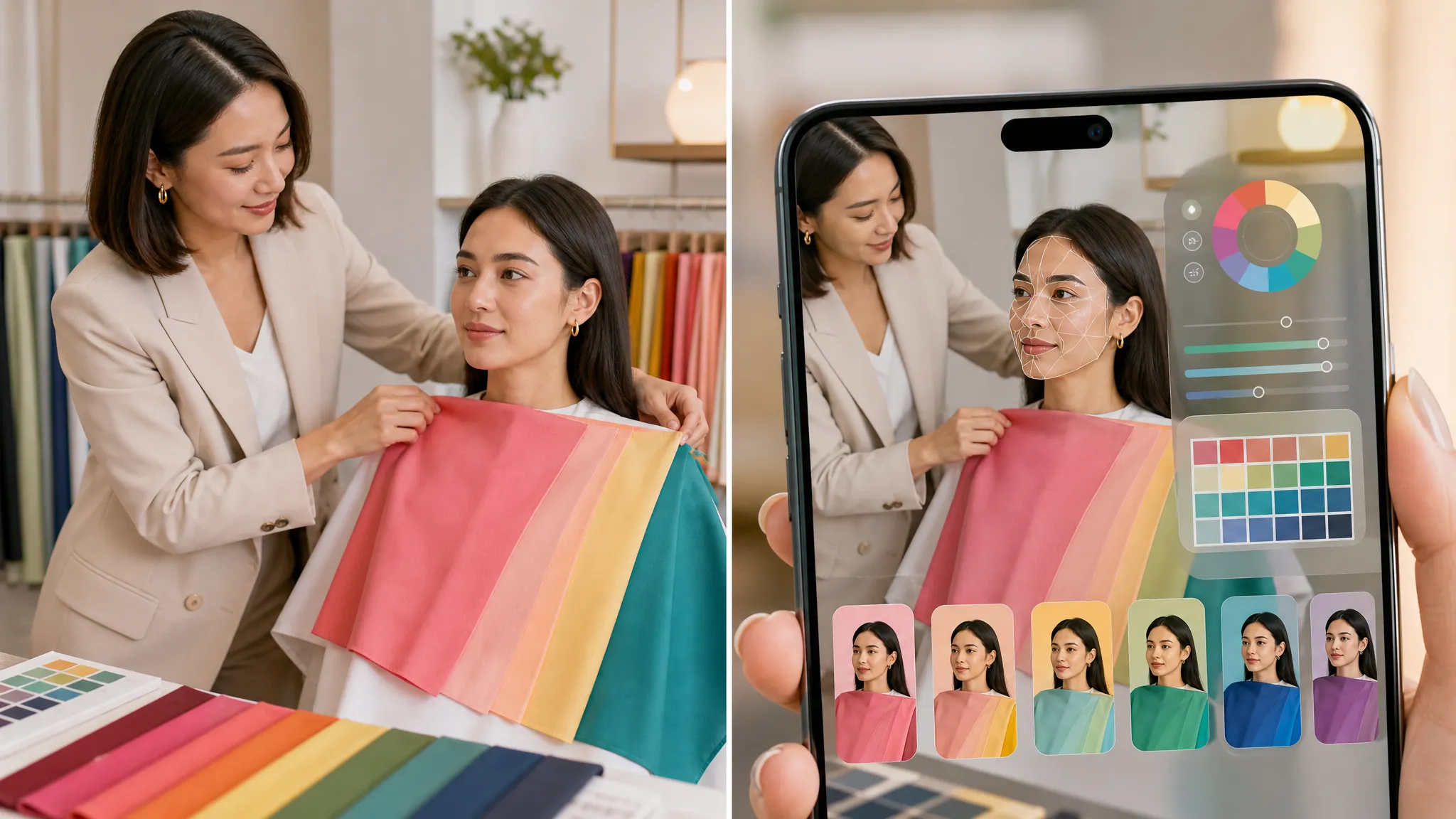
The draping process: The consultant held large fabric drapes against my chest, one color at a time, while observing how each shade affected my face. She started with the four main season groups (Spring, Summer, Autumn, Winter), then narrowed it down to sub-seasons.
What she looked for: Changes in skin tone (does this color make you look flushed or sallow?), under-eye shadows (do they deepen or fade?), the definition of your jawline, and how your eye color responded. Some drapes made my skin look smooth and even. Others made every flaw pop.
The verdict: After about 75 minutes and over 60 drapes, I was typed as a Deep Winter — high contrast, cool undertones, best in deep jewel tones and pure hues.
The Cost
The session cost $180 (prices range from $100–400 depending on location and analyst credentials). I also received a physical swatch booklet of my season's color palette to take shopping.
See your personal color palette now
Upload a photo — get your AI beauty report in 60 seconds.
What AI Color Analysis Looks Like
The AI approach is radically different in every way — speed, cost, and method.
The Process
I uploaded a selfie taken in natural light to an AI color analysis tool. The whole process took about 30 seconds. Here's what happened behind the scenes:
Photo analysis: The AI examined my skin tone, hair color, and eye color from the photo, along with the contrast between these features. Modern AI models are trained on thousands of professionally analyzed examples, so they've learned to recognize the patterns that human analysts look for — things like undertone warmth, saturation levels, and contrast ratios.
Feature extraction: The algorithm isolated my skin's undertone characteristics, checking for warm (yellow/golden) vs. cool (pink/blue) leanings, measured the depth and intensity of my natural coloring, and calculated the contrast between my skin, hair, and eyes.
Season matching: Based on these measurements, the AI matched me to the closest seasonal color type from the 12-season system.
The result: The AI typed me as — Deep Winter. Same result as the human analyst.
The Cost
Free to try, with premium features available in paid tiers. Total time investment: about 45 seconds.
The Detailed Comparison
After going through both experiences, here's how they stack up across the factors that actually matter.
Accuracy
Professional: The human analyst's greatest advantage is contextual judgment. She could see how colors reflected onto my skin in real time, adjust for lighting nuances, and consider factors like my natural flush pattern and how my skin changed over the course of the session. She also explained why certain drapes worked — "See how this cool red makes your eye color pop? That's the cool undertone at work."
AI: AI analysis works from a photo, which introduces some variables — lighting conditions, camera white balance, whether you're wearing residual makeup. However, modern AI models compensate for many of these factors automatically. When given a good-quality photo in natural light, the accuracy is surprisingly high.
My experience: Both methods gave me the same season (Deep Winter), which was reassuring. In my research, I've found that AI accuracy has improved dramatically over the past two years, particularly for clear-cut seasonal types. Where it still occasionally struggles is with borderline cases — people who sit right between two seasons.
Depth of Information
Professional: This is where the human analyst shines. My consultant didn't just tell me I was a Deep Winter — she showed me exactly which blues worked and which didn't, explained why certain neutrals would always be better than others, and gave me specific recommendations for my unique combination of features. She pointed out that while I'm firmly Deep Winter, I could borrow a few shades from True Winter for formal occasions. That nuance comes from years of training.
AI: AI tools typically provide your season classification, a recommended color palette, and sometimes specific makeup shade suggestions. Some apps offer detailed breakdowns of undertone analysis, contrast level, and complementary colors. What they generally don't offer is the conversational back-and-forth — the ability to ask "But what about this specific shade of green I love?" and get a real-time answer.
Convenience
Professional: You need to find a certified analyst (not always easy outside major cities), book an appointment, travel to the location, spend 60–90 minutes in the session, and go makeup-free. The entire process, from booking to completing the session, might take 2–3 weeks depending on availability.
AI: Open an app, take a selfie, get results. You can do it from your bed at 11 PM on a Tuesday. Repeat as many times as you want. Try different lighting. Share with friends instantly. The convenience factor isn't even close — AI wins overwhelmingly here.
Cost-Effectiveness
Professional: $100–400 for a single session. Worth it if you can afford it and have access, but it's a significant investment — especially when you consider that some people benefit from re-analysis as their coloring changes (hair goes grey, skin tans or lightens seasonally, etc.).
AI: Free or very low cost. You can re-analyze anytime — after a tan, after dyeing your hair, with different makeup looks — without spending another dollar. For someone who's curious but not ready to commit $200 to the question, AI eliminates the financial barrier entirely.
Accessibility
This might be the most important factor. There are approximately 5,000 certified color analysts worldwide. If you live in a major city in the US, UK, or South Korea (where color analysis is huge), finding one is easy enough. But if you live in rural areas, smaller countries, or regions where this isn't a thing yet? Your options are essentially zero.
AI color analysis is available to anyone with a smartphone. That's over 4 billion people. The democratization of this knowledge is, in my opinion, one of the most significant shifts in the personal styling industry in decades.
Where Each Method Truly Excels
After comparing both approaches carefully, I've come to a nuanced conclusion. It's not that one is "better" — they serve different needs.
Choose Professional Analysis If:
- You have the budget and access
- You're a borderline case between two seasons and need expert eyes
- You want a deeply personalized experience with real-time Q&A
- You're a fashion or beauty professional who needs precision
- You enjoy the experience itself as a form of self-care
Choose AI Analysis If:
- You want a quick, affordable starting point
- There are no analysts near you
- You want to track how your coloring changes over time
- You're curious but not ready to invest hundreds of dollars
- You want to experiment with different looks before committing
The Best Approach: Use Both
Here's what I actually recommend: start with AI, confirm with a professional if you want deeper guidance. Think of AI as the screening test and professional analysis as the specialist consultation.
Many people find that AI analysis gives them 90% of what they need — their season, their best colors, and the confidence to start shopping differently. The remaining 10% — the borderline calls, the personal styling nuances, the emotional experience of seeing yourself transform in a mirror — that's where a human analyst adds irreplaceable value.
The Technology Gap Is Closing Fast
Something worth noting: the gap between AI and professional accuracy is shrinking rapidly. Two years ago, AI color analysis was a novelty — fun but unreliable. Today, the best AI tools are trained on datasets of professionally analyzed faces, use advanced computer vision to detect subtle undertone variations, and deliver results that match professional assessments in the majority of cases.
Tools like aicoloranalysis.io are pushing this further by combining multiple analysis types — color season, undertone detection, face shape analysis, and personalized recommendations — into a single, instant experience. What used to require three separate professional appointments can now be explored in minutes.
This doesn't make human analysts obsolete. It makes color analysis accessible to millions of people who would never have experienced it otherwise. And that, I think, is the real story here.
Key Takeaways
- Both methods identified the same color season in my test — professional and AI analysis are more aligned than most people assume
- Professional analysis offers depth and nuance that AI can't fully replicate (yet), especially for borderline seasonal types
- AI analysis offers accessibility and affordability that professional sessions can't match — anyone with a phone can discover their colors
- The best strategy is complementary: use AI as your starting point, and invest in a professional session if you want the full experience
- AI accuracy is improving rapidly — what was a novelty two years ago is now a genuinely useful tool for personal styling
Related Articles
- Color Analysis: The Complete Guide — Everything you need to know about finding your best colors
Want to try AI color analysis yourself?
Upload one photo and get a magazine-level beauty report in 60 seconds.
Start Free Analysis