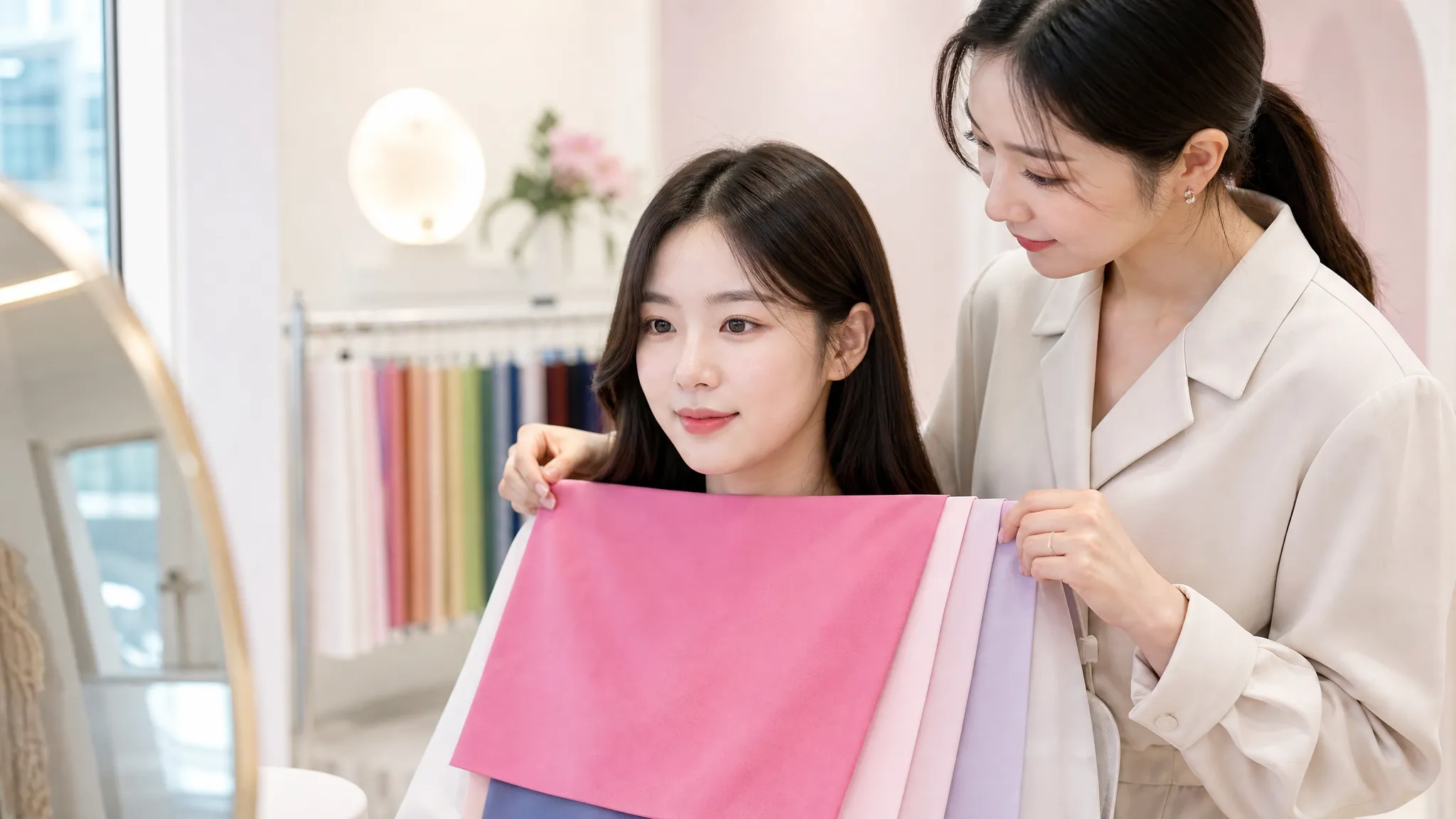
Korean Personal Color Analysis (퍼스널 컬러): Why It's Taking Over the World
What Is Korean Personal Color Analysis?
Korean personal color analysis (퍼스널 컬러 진단, "personal color jindan") is the Korean adaptation of seasonal color theory that has become a cultural phenomenon in South Korea and is now spreading globally through K-beauty, K-pop, and social media.
While based on the same Western color theory foundations (4-season and 12-season systems), the Korean approach has distinct characteristics:
- More granular sub-types — Korean colorists often use 16 or even 20 sub-seasons
- Emphasis on skin tone harmony — Specifically calibrated for East Asian skin tones
- Integrated with K-beauty — Directly linked to product recommendations
- Social/lifestyle tool — Used for everything from dating profiles to resume photos
Why Korea Is Obsessed with Personal Color
In South Korea, knowing your personal color is nearly as common as knowing your blood type. The trend exploded around 2019–2020 and shows no signs of slowing.
Cultural factors driving adoption:
- K-beauty culture — Koreans already invest heavily in looking their best. Color analysis is a logical extension.
- K-pop influence — Fans analyze their favorite idols' colors, creating viral content.
- Social media — Before/after color draping videos perform extremely well on Korean platforms.
- Dating culture — Many Korean dating profiles include personal color type.
- Professional benefits — ID photos and interview attire are chosen based on personal color.
Market size:
The Korean personal color industry is estimated at ₩100+ billion (roughly $75 million USD), with hundreds of specialized salons in Seoul alone, some charging ₩200,000–₩500,000 per session.
The Korean Color System
Traditional 4-Season Base
Korean color analysis starts with the same four seasons but uses Korean terminology:
| Korean | English | Characteristics |
|---|---|---|
| 봄 웜톤 (Bom Warm Tone) | Spring | Warm, bright, light |
| 여름 쿨톤 (Yeoreum Cool Tone) | Summer | Cool, soft, light |
| 가을 웜톤 (Ga-eul Warm Tone) | Autumn | Warm, deep, muted |
| 겨울 쿨톤 (Gyeoul Cool Tone) | Winter | Cool, deep, clear |
Korean 16-Season Extension
Many Korean colorists use a more detailed system:
Spring (봄):
- Light Spring (라이트 스프링)
- Bright Spring (브라이트 스프링)
- Warm Spring (웜 스프링)
- Vivid Spring (비비드 스프링)
Summer (여름):
- Light Summer (라이트 써머)
- Bright Summer (브라이트 써머)
- Cool Summer (쿨 써머)
- Mute Summer (뮤트 써머)
Autumn (가을):
- Mute Autumn (뮤트 오텀)
- Warm Autumn (웜 오텀)
- Deep Autumn (딥 오텀)
- Strong Autumn (스트롱 오텀)
Winter (겨울):
- Deep Winter (딥 윈터)
- Cool Winter (쿨 윈터)
- Bright Winter (브라이트 윈터)
- Vivid Winter (비비드 윈터)
How Korean Color Analysis Differs from Western
Focus on Asian Skin Tones
Korean colorists are specifically trained to identify undertone differences in East Asian skin, where:
- The warm/cool distinction can be subtler than in Caucasian skin
- Yellow undertone is common but doesn't automatically mean "warm" (it can be cool-yellow vs. warm-yellow)
- Olive undertone in Asian skin is read differently than in Mediterranean skin
Product Integration
Unlike Western analysis that stops at "you're an Autumn, wear these colors," Korean colorists provide:
- Exact product shade names (e.g., "You should use MAC Velvet Teddy" or "Try Romand Juicy Lasting Tint #13")
- Hair color codes with level and tone numbers
- Foundation shade matching across Korean brands
- Contact lens color recommendations
The "Best Color" Concept
Korean analysis identifies your single strongest "best color" (베스트 컬러) — the one shade that makes you look most vibrant. This is often the color used for ID photos or important events.
How to Get Korean-Style Color Analysis
In Seoul
Popular color analysis salons include:
- Myday Color (마이데이컬러) — Gangnam, from ₩150,000
- Color Dear (컬러디어) — Hongdae, from ₩120,000
- Personal Tone Lab — Apgujeong, from ₩200,000
Most sessions include:
- Pre-consultation (skin assessment under standard lighting)
- Draping with 100+ color swatches
- Best/worst color identification
- Makeup color recommendations
- Photo documentation of results
- Personal color card (color swatches to carry)
Outside Korea
The trend has spread to:
- Japan — パーソナルカラー (personal color) salons in Tokyo and Osaka
- China — 个人色彩诊断 services in major cities
- Southeast Asia — Growing presence in Bangkok, Singapore, and Manila
- Western countries — Korean-trained analysts offering services in NYC, LA, London
Online / AI Options
For those who can't visit a Korean salon:
- AI color analysis tools can provide accurate Korean-style typing
- Video consultations with Korean colorists are available (₩80,000–₩150,000)
- Self-assessment guides in Korean are widely available on Naver
K-Pop Idols and Their Color Seasons
Personal color analysis of K-pop idols is hugely popular content:
- IU (아이유) — Often typed as Light Spring or Bright Spring
- Jennie (BLACKPINK) — Commonly identified as Autumn (Warm or Deep)
- V (BTS) — Frequently typed as Deep Winter or Cool Winter
- Tzuyu (TWICE) — Often categorized as Cool Summer
These celebrity typings drive fan engagement and help people identify their own seasons by comparison.
Try AI Color Analysis (Korean-Style Accuracy)
Our AI has been trained on diverse skin tones including East Asian coloring, providing results comparable to Korean salon-style analysis. Get your 12-season type, best colors, and makeup recommendations instantly.
60 seconds, free, no signup. Available in Korean (한국어) and 15 other languages.
Want to try AI color analysis yourself?
Upload one photo and get a magazine-level beauty report in 60 seconds.
Start Free Analysis