Why Celebrity Makeup Tutorials Never Work on You (And What Will)
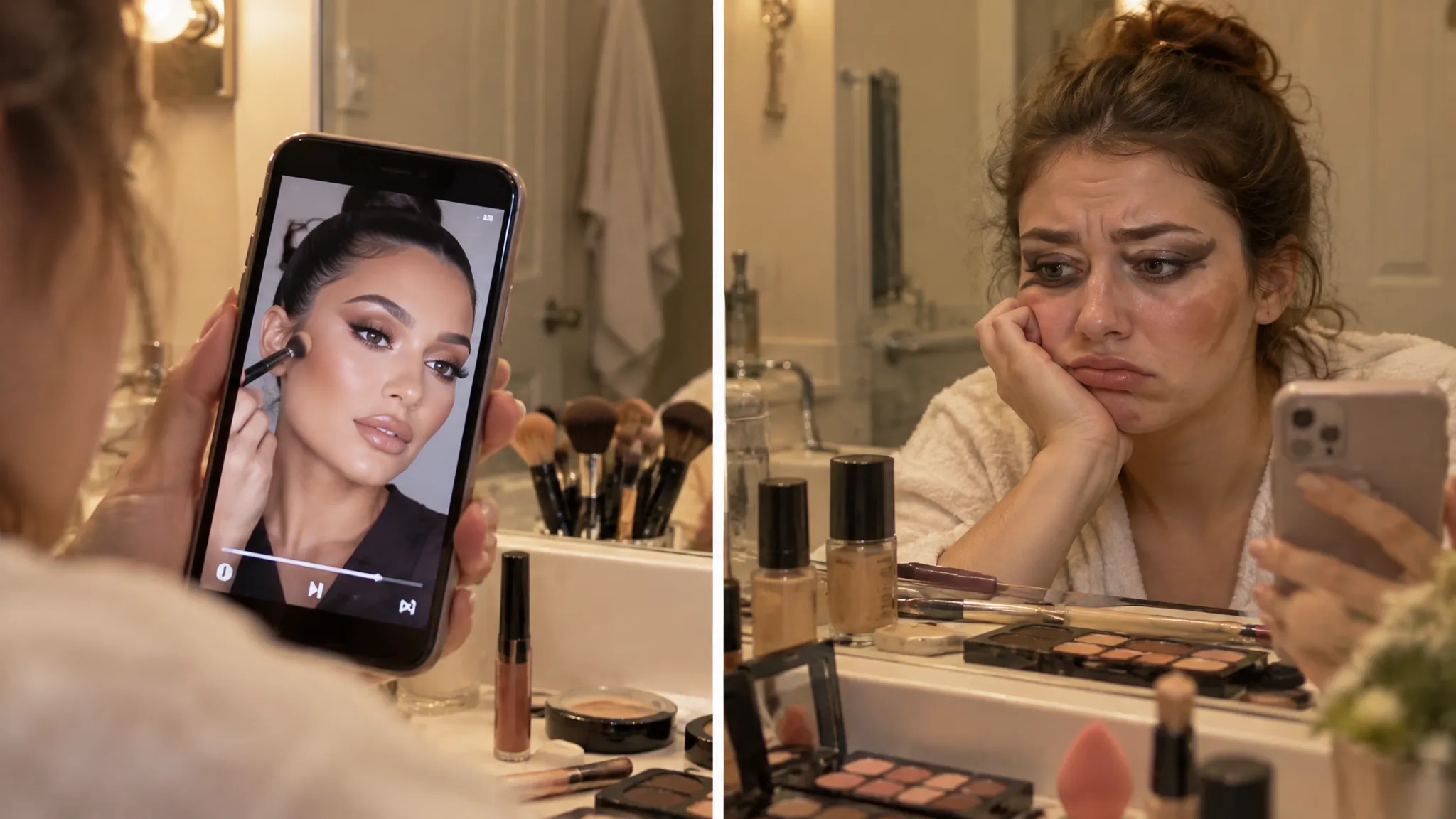
The Tutorial That Looked Perfect on Her and Wrong on Me
I'll never forget the night I spent forty-five minutes recreating a celebrity makeup tutorial step by step. Same products. Same brush strokes. Same order of application.
In the video, her skin looked luminous. Her eyes looked huge and defined. The berry lip felt sophisticated and effortless.
On me? The foundation pulled orange. The taupe eyeshadow made my eyes look tired. The berry lip aged me by ten years.
I blamed my technique. I bought better brushes. I watched the video again, pausing at every blend.
Nothing changed — because the problem was never my blending skills. The problem was that I was applying colors designed for someone with completely different coloring than mine.
If you've ever had this experience, you're not bad at makeup. You're following instructions written for a face that doesn't share your undertone, contrast level, or color season. And once you understand that, celebrity makeup stops being a trap and becomes a genuinely useful reference system.
Why Celebrity Makeup Tutorials Fail (Even When You Follow Every Step)
Celebrity makeup tutorials are optimized for one thing: making that specific celebrity look incredible on camera. They are not optimized for you.
Professional makeup artists working on celebrities know something most tutorial viewers never hear: the products matter less than the color relationship between those products and the person's natural features.
Undertone Mismatch: The Foundation of Every Failure
Every face has an undertone — the subtle warm, cool, or neutral cast beneath the surface of the skin. Makeup that matches your undertone disappears into your skin. Makeup that fights it sits on top like a mask.
Celebrity tutorials rarely mention undertone because the artist already selected products calibrated to that celebrity's skin. When you buy the exact same foundation shade, you're assuming your undertone matches theirs. Often, it doesn't.
I've seen this play out constantly with warm-toned celebrities recommending peachy blushes and golden bronzers. On a cool-toned viewer, those same products read as orange and muddy. The technique is flawless. The color temperature is wrong.
Contrast Level: Why Their Smoky Eye Overwhelms Yours
Contrast level describes how much visual difference exists between your hair, skin, and eye color. High-contrast faces — think dark hair, fair skin, vivid eyes — can carry bold, graphic makeup without looking overdone.
Low-contrast faces — soft hair, soft eyes, gentle skin tone transitions — get swallowed by the same intensity. What reads as "smoldering" on a Deep Winter celebrity reads as "heavy" on a Soft Summer viewer.
This is why a tutorial's black winged liner and charcoal crease shade can look editorial on one person and harsh on another. Same products. Different contrast capacity.
Face Shape: The Factor Tutorials Mention But Undersell
Face shape absolutely affects placement — where to contour, how far to extend blush, where to stop your eyeshadow. But tutorials often treat face shape as the primary variable when color is doing most of the heavy lifting.
You can adjust placement all day long. If the blush shade is too warm, too cool, or too saturated for your coloring, no amount of angling will save the look.
In my experience, face shape adjustments account for maybe 20% of why a celebrity look translates well. Undertone and contrast account for the other 80%.
See your personal color palette now
Upload a photo — get your AI beauty report in 60 seconds.
The 3 Invisible Factors That Decide Whether Makeup Works
Before you follow another celebrity tutorial, understand these three variables. They operate below conscious awareness — which is exactly why copying fails so silently.
Factor 1: Undertone (Warm, Cool, or Neutral)
Your undertone determines whether gold or silver jewelry flatters you, whether peach or pink blush looks natural, and whether a nude lip harmonizes or disappears.
Warm undertones have golden, peachy, or yellow bases. Cool undertones lean pink, red, or blue. Neutral undertones sit between the two.
When a celebrity with warm undertones uses a golden bronzer and peach blush, she's working with her skin's natural temperature. Apply those same shades on cool skin and the effect is jarring — like wearing someone else's face.
Research published in Color Research & Application confirms that people consistently rate faces as more attractive when surrounding colors harmonize with natural skin coloring. Makeup is just color surrounding your face. Harmony is non-negotiable.
Factor 2: Contrast Level (High, Medium, or Low)
High-contrast faces can handle high-contrast makeup: bold lips, sharp liner, deep crease shades. The makeup matches the natural drama of their features.
Low-contrast faces need softer transitions. A diffused brown liner replaces a sharp black wing. A sheer lip stain replaces a full opaque red. The makeup intensity should mirror the intensity already present in your natural coloring.
I learned this the hard way trying to recreate Rihanna's bold red carpet lips. The color was stunning on her high-contrast features. On my medium-contrast coloring, it dominated my entire face.
Factor 3: Color Season (Your Complete Color Profile)
Color season combines undertone, contrast, and depth into a 12-type system. It tells you not just whether you're warm or cool, but how light or deep your coloring runs, and how muted or vivid your features appear.
Two people can both have warm undertones and still need completely different makeup. A Bright Spring needs vivid coral lips and shimmery gold lids. A Soft Autumn needs dusty peach and matte taupe. Same warmth. Opposite intensity.
Your color season is the cheat code celebrity makeup artists use — they just don't put it in the YouTube description.
How to Find YOUR Celebrity Makeup Match
The fix isn't to stop watching celebrity tutorials. It's to watch the right celebrities — ones who share your color season and contrast level.
When someone shares your season, their best makeup looks use colors that will work on you too. Not identical shades necessarily, but the same color logic: same temperature, same depth, same saturation level.
Step 1: Identify Your Color Season
Before matching with any celebrity, you need to know your own season. Are you a cool, muted Soft Summer? A warm, vivid Bright Spring? A high-contrast Deep Winter?
If you're unsure, study how different color families react with your skin. Do warm peachy shades make you glow or look sallow? Do cool pinks brighten you or make you look washed out?
For a deeper framework, our guide on decoding any celebrity's color season walks through the same temperature, value, and chroma signals professionals use.
Step 2: Find Celebrities in Your Season
Once you know your season, seek celebrities with similar coloring — not similar style, similar coloring. Same undertone. Similar contrast. Similar depth.
A Light Summer shouldn't study Deep Winter makeup tutorials, even if she loves the aesthetic. She should study Light Summer celebrities — people whose fair, cool, low-contrast coloring responds to the same soft pinks, cool taupes, and sheer finishes.
If you want a head start on identifying your match, see our article on finding your celebrity color season style twin for recognizable examples across all 12 seasons.
Step 3: Study Their Makeup, Not Their Products
When you find your color-season match, stop copying product names. Start copying color roles.
What undertone is their foundation? What depth is their lip color relative to their skin? How saturated is their blush compared to their natural flush?
A True Autumn celebrity might wear a rich terracotta lip. Your equivalent isn't her exact lipstick — it's your season's terracotta, which might be a warm cinnamon or burnt rose depending on your depth.
This shift from product copying to color logic copying changed everything for me. I stopped buying shades that looked beautiful in the pan and started buying shades that looked beautiful on my face.
Your Season-by-Season Celebrity Makeup Guide
Different seasons need different celebrity references. Use this table as a starting point — then dive deeper into the makeup specifics for your season in our complete makeup color chart.
| Color Season | Celebrity Reference | Signature Makeup Moves | What to Avoid |
|---|---|---|---|
| Light Spring | Margot Robbie, Scarlett Johansson | Peachy blush, champagne lids, warm pink lips, dewy golden highlighter | Heavy smoky eyes, cool mauve lips, dark matte contour |
| True Spring | Jessica Chastain, Amy Adams | Warm coral lips, golden bronze eyes, peach blush, luminous skin | Cool pink blush, ashy brows, blue-red lipstick |
| Bright Spring | Jennifer Lopez, Beyoncé | Vivid coral lips, bright gold lids, clear warm blush, bold but warm color | Dusty muted tones, cool gray eyeshadow, brownish nude lips |
| Light Summer | Taylor Swift, Cate Blanchett | Soft rose blush, cool taupe eyes, sheer pink lips, subtle silver highlight | Warm peach tones, heavy bronzer, orange-based coral |
| True Summer | Emily Blunt, Keira Knightley | Cool rose lips, soft teal or navy liner, muted berry blush | Warm terracotta, golden bronzer, orange-red lipstick |
| Soft Summer | Dakota Johnson, Gigi Hadid (natural coloring) | Dusty mauve lips, soft gray-brown eyes, muted plum blush | High-saturation colors, warm orange tones, stark black liner |
| Soft Autumn | Jennifer Aniston, Gigi Hadid (warmer looks) | Dusty peach lips, matte taupe eyes, soft terracotta blush | Bright fuchsia, cool silver shadow, icy highlighter |
| True Autumn | Julia Roberts, Julianne Moore | Warm cinnamon lips, copper or olive eyes, terracotta blush | Cool pink lipstick, ashy contour, blue-based red |
| Deep Autumn | Eva Mendes, Salma Hayek | Rich berry or brick lips, deep bronze eyes, warm sculpting | Pastel shades, cool frosts, light airy colors |
| Deep Winter | Lupita Nyong'o, Lucy Liu | True red or fuchsia lips, graphic liner, high-contrast color blocking | Warm peachy tones, muted dusty shades, orange-based products |
| True Winter | Anne Hathaway, Liv Tyler | Cool berry lips, silver or icy shadow, crisp black liner | Warm golden bronzer, peach blush, brown-based nudes |
| Bright Winter | Olivia Rodrigo, Fan Bingbing | Vivid fuchsia or blue-red lips, bold graphic eyes, high-shimmer highlight | Muted earthy tones, warm caramel shades, soft diffused looks |
How to Use This Table in Practice
Pick your season row. Watch makeup content featuring that celebrity — red carpet prep videos, beauty interviews, even paparazzi shots with visible makeup.
Notice patterns. Soft Summers consistently look best in blurred, muted tones. Bright Winters consistently look best with clean, saturated color and sharp definition.
Then translate. You don't need their exact products. You need their color temperature, their intensity level, and their contrast approach.
A Soft Autumn recreating Jennifer Aniston's look should reach for dusty peach blush, not Jennifer's exact NARS shade. A Deep Winter inspired by Lupita should focus on true, blue-based reds — not the specific brand on her lips.
Vogue's guide to finding makeup for your skin tone reinforces the same principle professional artists use on set: match the color story to the person's natural coloring before worrying about trends or products.
The Color Translation Method for Any Tutorial
Even when a tutorial features a celebrity outside your season, you can still salvage the technique. I call this color translation — keeping the structure, swapping the shades.
Step 1: Identify the color role of each product. Is the lipstick a "bold statement lip" or a "your-lips-but-better nude"? Is the eyeshadow a "soft wash of color" or a "smoky dramatic crease"?
Step 2: Find the equivalent shade in your season's palette. A Bright Spring's bold coral lip becomes a Soft Summer's muted rose lip. Same role — statement lip — different shade.
Step 3: Adjust intensity to your contrast level. High-contrast faces can keep the original saturation. Low-contrast faces should sheer out or soften every product by one level.
Step 4: Match foundation undertone first. Nothing else matters if your base is fighting your skin. Get the undertone right, then build everything else on top.
I've used this method to adapt countless tutorials that weren't designed for my Soft Autumn coloring. The placement stays. The colors change. The result finally looks like it belongs on my face.
Modern Solutions
Finding your color season and celebrity match used to mean booking a professional color analysis and studying red carpet archives for hours. Today, AI tools can analyze your undertone, contrast level, and season from a single photo — then surface celebrities who share your coloring profile.
If you want a data-informed starting point rather than guesswork, Belle AI at aicoloranalysis.io offers celebrity matching and makeup analysis that map your features to season-appropriate shades and reference faces. I still recommend trusting your mirror when a product feels wrong — but having an objective read on your undertone and season removes most of the trial-and-error that makes celebrity tutorials so frustrating.
The goal isn't to outsource your judgment. It's to arrive at the right color framework faster, so the tutorials you follow actually have a chance of working.
Key Takeaways
- Celebrity makeup tutorials fail because they're calibrated to one person's undertone, contrast level, and color season — not yours
- Undertone mismatch is the most common reason foundation, blush, and lips look "off" despite perfect technique
- Contrast level determines how much makeup intensity your face can carry without looking overdone
- Your color season is the complete framework that tells you which color families, depths, and saturations harmonize with your features
- Find celebrities who share your season and study their color logic — not their exact product list
- Use the color translation method to adapt any tutorial by keeping color roles and swapping specific shades
- AI color analysis can identify your season and celebrity matches quickly, giving you a reliable reference point before you buy another wrong lipstick
The Real Lesson Celebrity Tutorials Teach
Celebrity makeup tutorials aren't useless. They're mislabeled.
They aren't universal instructions. They're case studies — detailed documentation of what works on one specific coloring profile.
Once I stopped asking "how do I look like her?" and started asking "what would this look like on someone with my coloring?" everything changed. I still watch tutorials for technique inspiration. I still admire bold red carpet looks.
But now I filter every product recommendation through my season first. And the forty-five-minute recreations actually end with me recognizing the face in the mirror.
The best celebrity makeup reference isn't the most famous one. It's the one whose natural coloring matches yours — because her best looks are already proof of what your face can do.
Related Articles
- Which Celebrity Has Your Color Season? Find Your Style Twin — Find your celebrity color match
- How to Decode Any Celebrity's Color Season (And Steal Their Best Style Moves) — Decode celebrity style logic
- The Best Makeup Colors for Every Color Season: A Complete Chart — Your complete makeup color guide
- Color Analysis: The Complete Guide — Everything you need to know about finding your best colors
Want to try AI color analysis yourself?
Upload one photo and get a magazine-level beauty report in 60 seconds.
Start Free Analysis